
1) þribblingar (derived from þribbill, scandium, þrí + B +-ill (in diminutive sense), the first and lighterst element of group 3B, see Scandium)
2) þyrsingar, þursaglitsættingjar, þursglitingar, titanium-group elements, after þursaglit, þyrsi (titanium)
3) vanskmálmar, vönungar, vanynjungar, vanadium group element (the wanish metals, after Vanadís from which vanadium is derived)
4) glitherðingar (chromium-group, named after glitarður, chromium)
5) málmynjungur (the manganese family of element, after málmynja or jerna (manganese)
6) járnungar (the ferromagnetic triad Fe, Co and Ni)
7) hvítgyllingar, silfringar (the platinum group of elements, after hvítagull (white gold, platinum)
1) Scandium:
1) þribbill: (Acronym composed of þrí- (three) + B Scandium is the first element in group 3B, with addition of the suffix -ill, which is sometimes used in a diminutive sense in some Icelandic words, like the much more common -lingur or -ungur. This diminutive sense refers to scandium is the lightest element in group 3B and belongs to the "léttir málmar". So yes, þribbill, why not, it's a different construction but a word out of one piece and the other elements of the group: yttrium, lanthanum and actinium are þribblingar.

The best option is Ífumálmur, after Iveland, where the mineral was found. The element was actually named after Scandinavia as a whole, but it can be narrowed down to the very type-locality of the mineral. I searched Iveland on the mineral database if it is the type-locality of other minerals and yes, also Davidite is found there, but this is only an unimportant cerium-rich rare earth mineral. http://www.mindat.org/typelocs-32512.html
The names Ljosland and Knipan are the places within the municipality where the mineral was found, but I decided not to narrow down so far because these names would make long or akward constructions like Ljóslandsmálmur or Gnípansmálmur (knipa means "mountain top" and is equal to Icelandic nípa and gnípa). The Old Norse river-name Ífa, which is identical to Ive in Iveland is much older than the names Ljosland and Knipan, which have no Old Norse forms.
I also refused using Agðamálmur, because many type-localities of rare earth minerals other than Scandium minerals are found there. No, we need to narrow it down to Iveland.
For that reason I choose the Old Norse form Ífa as the first part of the name for Scandium: Ífumálmur
Ífa kv † árheiti (í skáldam.); virðist einnig koma fyrir í nno. örn.. Sjá Ífing
Ífing kv. † árheiti (í skáldam.). Orðstofn þessi virðist líka koma fyrir sem árheiti í norskum örnefnum, samanber nýnorsku Ivedal og Iveland (N. Undal); samanber og Ifa árheiti (í forníslensku skáldamáli). Nöfnin hafa verið talin tengd trjáheitinu ýr (s.þ.) (<*Íving og *Iva) og merking þá 'sú sem rennur gegnum ýviðarlendur'. Óvist. Aðrir ætla að þessi árheiti séu í ætt við nýháþýsku eifer of hollensku ijver 'ákafi, ofsi, ...' og ætti nafngiftin þá líklega við straumharðar ár. Íslensk Orðsifjabók
The municipality (originally the parish) is named after the old Iveland farm (Old Norse: Ífuland), since the first church was built there. The first element is the genitive case of the river name Ífa (now Frøysåna) and the last element is land which means "land" or "farm". The old river name is probably derived from the Norse word ýr which means "yew" (Taxus baccata). http://en.wikipedia.org/wiki/Iveland
1) Titanium:
þursaglit, þyrsi, þursamálmur
After many tryouts, I wondered if maybe an i-shift derivation þyrsi form "þurs" (old form of þursi) could do the trick? How many elements are actually named after mythological giants. Þyrsi as a name for titanium has many advantages:
- A short and flexible term, an i-shift of a noun, something that has been done before by Icelandic chemist in the creation of native names of chemical elements: e.g. ildi (oxygen, from eldur, (fire), vetni (hydrogen) from vatn (water), lyfti (nitrogen) from loft (air), and non-existent in Modern Icelandic, but nevertheless possible: kelki (calcium) from kalk, telki (magnesium) from talk, sendi (silicon) from sand (sand), eski (potassium) from aska (ash), selti (chlorine) from salt, þengi (iodine), from þang (seaweed). Because titanium is after all the 4th most abundant metal in the earth's crust, it deserves an equally short name.
- þyrsi alludes to mythological giants, not specifically to titans, so the link with the original idea is retained. Titanium is a strong, hard and corrosion-resistant metal, so the one who discovered the element, although at the time unaware of these properties, made a very appropriate choice.
- The first syllable of the word sounds similar to the first syllable in "titanium".
I was thinking by myself, how many metals are actually named after mythological giants? Well, actually only one. The interesting thing is that þyrsi marries the original idea of naming the element after mythological giants with a typical method of creating names for elements, while retaining some sound-similarity with the international term in the first syllable. If you asked an Icelandic chemist which element he thought would be most appropriate to bear the name "þyrsi", he would definitely go for titanium.

2) Vanadium
1) freyjujárn as a designation of vanadium is an obvious choice, because Vanadísar- would be too long. Still, a short cut is possible here: Vanadís, one of the godess Freyja's nick-names, literally means "wane-godess", despite the fact that there are more female members in this family of deities.
The only chemical element is vanadium that is linked with something Wanish is vanadium.
2) fimbulglit (fimbul in the sense of "element from group 5B (five = fimm + b + suffix -ull to match it with the already existing prefix fimbul-, which, in combination with glit "lustre" forms fimbulglit "enormous, extreme lustre", which applies to vanadium.
3) vanynjumálmur: We don't have to use vanadísarmálmur, we can reduce it to vanynjuglit (waness' sheen) or even vanskmálmur (Wanish metal). The noun vanadate can be translated with the adjective vansksýrður: e.g. ammonium hexafluorovanadate : sexflúrumvansksýrt lútarloft, yttrium vanadate: vansksýrður svíamálmur/jölmstarmálmur, vansksýrt ilmstri;
4) súrjörðungur (The first element of the "acidic earth metals". "Acidic earth" is the translation of German säure erden or erdsäuren, an old German term for the natural oxides of the group 5B metals. Because vanadium is the first element in this group, it can be named súrjörðungur. http://de.wikipedia.org/wiki/Erds%C3%A4uren

3) chromium
1) glitarður
Chromium is the hardest metal (8.5-9 on moh's scale wolfram with 7.5 ranks second) and also takes the highest lustre. Only the combination these two obvious properties in one word is likely to produce a sufficiently transparent native term for this element.
Why not using -arður (from -harður) as a suffix on glit-. In Icelandic, the "h-" in the second element -harður in marculine personal names is sometimes omitted. In the mannanafnaskrá, I found a few examples like Geirarður (but mostly it is Geirharður), but the adjective einarður comes from ein-harður (Stafsetningaorðabók, Halldór Halldórsson). The omission of the "h" in personal names isn't as pronounced in Icelandic as it is in other languages: Eckart (from German Eggehard, Icelandic Eggert), Bernard (Dutch form).
In French words -ard originates from the latter element -ard in Bernard and it began to lead its own life: When it was adapted to common names it got a pejorative meaning: blanchaert.
In Icelandic quite some words end in -arður like mustardur, bastarður, so glitarður doesn't have to suffer the inconvenience of looking like a personal name, while -arður can still refer to "harður"
The ending also sound like -varður (but when the -v is omitted, the form usually becomes -urður, like in Sigurður, still of lustre and chromium iit also sounds a bit like -varður (Glitvarður) protector s the anti-rust metal supreme.
to chrtomate: brynja glitarði, glitherða
þessi eru nöfn glitarðs: brynskin (armouring shine), þolgljái (resistant lustre), óryð (unrust) og ylfingajárn (iron of the wolfram group)

The elements of the chromium group are called glitherðingar
4) manganese
málmynja (the metal from the feminine ore)
Manganese resembles iron and is often found associated with the latter in nature. From the viewpoint of the history of mineral terminology, the relationship between these two elements is expressed by the shared etymological root of "magnet" (original meaning, magnetic iron (Fe, seguljárn) or lodestone, seguljárnsteinn, leiðarsteinn) and "manganese": The name of the city of magnesia. http://en.wikipedia.org/wiki/Manganese
This relationship between manganese and iron can hardly be expressed any better than the way ancient and medieval mineralogists distinguished between the similarily-looking black ores of both elements. The two black minerals from Magnesia (magnetite and pyrolusite) were both called magnes from their place of origin, but in order to distinguish between them terminologically, they were, yes, GENDERIZED.
The male magnes ore attracted iron, and was the iron ore we now know as lodestone (leiðarsteinn) or magnetite (Fe3O4), and which probably gave us the term "magnet". Manganese resembles iron and is often found associated with the latter in nature. From the viewpoint of the history of mineral terminology, the relationship between these two elements is expressed by the shared etymological root of "magnet" (original meaning, magnetic iron (Fe, seguljárn) or lodestone, seguljárnsteinn, leiðarsteinn) and "manganese": The name of the city of magnesia. http://en.wikipedia.org/wiki/Manganese
This relationship between manganese and iron can hardly be expressed any better than the way ancient and medieval mineralogists distinguished between the similarily-looking black ores of both elements. The two black minerals from Magnesia (magnetite and pyrolusite) were both called magnes from their place of origin, but in order to distinguish between them terminologically, they were, yes, GENDERIZED.
The female magnes ore did not attract iron, but was used to decolorize glass. This feminine magnes is now known as pyrolusite or manganese dioxide MnO2 (German: braunsteinn, Icelandic: brúnsteinn). The name magnesia eventually was used to refer only to the white magnesia alba (magnesium oxide, MgO), which provided the name magnesium for that free element, when it was eventually isolated, much later. http://en.wikipedia.org/wiki/Manganese (see under "History")
So the male magnesia was the magnetic iron ore magnetite (Fe3O4), which contained iron and no manganese.
The feminine magnesia was the non-magnetic pyrolusite or MnO2, the chief manganese ore.
If we translate this avenue of thought into Icelandic constructions, we end up with five different possibilities: jerna, kvenjárn, melma, kvenmálmur, málmynja and segulsystir
The only two that appeals to me is málmynja and járnsbrúður or jerna, the first one because it's having the same initila character as manganese. It is always an advantage that a native term still exhibits some phonetical similarity with the international word, even without any etymological connection. This represents a neologistic strategy not uncommonly applied by professional Icelandic terminologists, an often-mentioned example of which is the famous ratsjá (rata "find one's way" + sjá (-scope as in microscope), which does sound somewhat similar to its English equivalent radar, but without any etymological connection of course, radar being an acronym for radio detecting and ranging.
As for málmynja, I think it is the best of our six candidate-neologisms for "manganese": I-shifting járn into jerna is risky. I can't help worrying that this construction might sound a bit outlandish in icelandic ears. It's an accurate derivation, but I failed to find examples like jerningur or compounds ending in -jerni in the literature. Moerover the word doesn't possess the advantage of having an initial "m" as in the case of málmynja. Melma, on the other hand, has the initial "m" but sounds too similar to melmi, which means "alloy". And kvenjárn or kvenmálmur also lack the advantage of an initial "m" and are therefore also less appropriate choices. So that leaves us with málmynja.
In the case of manganese, the is most convenient word to derive from is málmur, and not járn, because the "manganic black magnesia" was the "the female ore", not the "female iron" and "málmur" in its original sense actually stood for "ore".
Finally there is some misconception about the use of the suffix -ynja that has to be put to rest. I heard this prefix is sometimes regarded as being West-Germanic in origin and that kven- constructions are to be preferred in Icelandic. I checked the Íslensk orðsifjabók and found out that this not the case. The suffix -ynja is a pangermanic, which also means a Scandinavian suffix. The fact that in Icelandic, the majority of the words nowadays are put in a feminine form by prefixing kven- doesn't mean that the use of -ynja for this purpose is to be considered wrong and unicelandic.
The translation of the tem "manganate" could be: compound with the noun with the adjectives brúnsteinssýrður" is also possible (brúnsteinn, from German braunsteinn, pyrolusite, MnO2)
potassium permanganate (KMnO4): hábrúnsteinssýrður öskumálmur, hábrúnsteinssýrt eski or hámálmynjungseski
For the elements of the Magnesium group, the term málmynjungar (málmynja, the female metal, manganese, + -ungur (suffix used in collective family names, like -hjaðningar (from Skarphéðinn).

járn, ísarn
6) cobalt
1) blámamálmur: The authors of the Volcan language, another artificial language aside from Klingon related to the Star Trek series, surprisingly created a dictionary that contained the names of the chemical elements, so I was interested to see how far they went in their efforts and what they came up with. At first glance, it rather looked disappointing: all names ended on -tukh (substance, -ium), but the ideas behind some of their coinings were interesting.
Cobalt was named pla-tukk (blue colour metal). Until now I have been reluctant to name cobalt after its historical role in the form of a blue pigment and this has to do with the fact that other elements have compounds used as a blue dye, but they are much less more important. On the wikipedia article about cobalt (see history) you see that, historically "cobalt" is inextricably wound up with the idea of "a blue dye". http://en.wikipedia.org/wiki/
In the 19th century, the hungarian term for cobalt was kékleny, which was derived from kéklik (appear/look blue).
In the 19th century, the hungarian term for cobalt was kékleny, which was derived from kéklik (appear/look blue).
An East Scandinavian name for cobalt wouldn't have been impossible for the first large cobalt mines in history were opened at Modum, Norway. So I think the authors of the "language of logic" made a point here. For that reason I think blámamálmur is better than dyrgi. the word sounds funny because part of the compound is a palindrome: blámamálmur
2) dyrgi (from dvergur): The only ferromagnetic element named after a "kind of dwarf". On the analogy of titanium -þyrsi and the tendency to use i-shifts of words for names of elements (ildi, vetni, hyldi), I went for dyrgi in the case of cobalt. Fjörvamálmur (referring to the fact that it is the only metal in a vitamin (vit. B12), móðheimsmálmur (after Modum, Móðheimur, Norway, where the first large cobalt mine of Europe was situated (Blaafarveværket)).
3) fjörvamálmur (vitamin -metal, cobalt is the only metal found in a vitamin, namely vitamin B12, cyanocobalamine)
3) fjörvamálmur (vitamin -metal, cobalt is the only metal found in a vitamin, namely vitamin B12, cyanocobalamine)
4) smelti, smaltmálmur (i-shift of smalt (cobalt blue glass))
7) nickel
1) hvíteir (The silvery-white metal left from the reddish-brown copper. The same situation is found two periods up: hvítagull (platinum) is situated left from the yellowish gold.

2) segulglit: refers to nickel's ferromagnetic properties: leiðarsteinn (lodestone) is the the old Icelandic word for magnetic iron ore. The prefix leiðar- could serve as a modern term for "ferromagnetic" and is shorter than samsegul- or járnsegul-. Leiðarglit could be translated as "lodelustre". It is the most noble of the ferromagnetic triad (iron, cobalt and nickel).
3) myntjárn
8) copper
Eir, kopar, rauðmálmur
9) Zinc
1) eirgyllir (goldener of copper)
2) freysmálmur: Named after Freyr, the phallic, male fertility god. Zinc is the prime mineral for male fertility.
There are 2-4 grams of zinc distributed throughout the human body. Most zinc is in the brain, muscle, bones, kidney, and liver, with the highest concentrations in the prostate and parts of the eye. Semen is particularly rich in zinc, which is a key factor in prostate gland function and reproductive organ growth. See http://en.wikipedia.org/wiki/Zinc#Biological_role
10) Zirconium
1) hliðartin (transition-tin, the element in group 4B on the same period as tin (4A)
2) jarknamálmur, irkni
One of the possible etymologies that were presented for the old and almost obsolete prefix jarkna- in jarknasteinn (gem-stone) is the Chaldean jarkān (yellow gem-stone), which is identical to the Persian zargun (zar- golden + gun coloured), which is a borrowing of Arabic, related to Chaldean.
jarknasteinn k. † 'gimsteinn, eðalsteinn'. Líklega tökuorð úr fornensku eorcnanstān, earcnanstān. Uppruni óljós. Ef til vil tökuorð úr kaldeísku jarkān 'gulleitur gimsteinn'. Aðrir telja orðið af germanskum toga, samkvæmt fornsaxnesku erkan, fornháþýsku erchan 'ósvikinn, réttur, gotnesku airknida 'hreinleiki', samanber latínu argentum 'silfur', grísku argós 'bjartur'. Óvíst Athuga jarteikn og orkn. (Íslensk orðsifjabók).
It is most likely a borrowing from Old English indeed and has nothing to do with the originally Chaldean name. Nevertheless, the fact that it's an obsolete term and similar in sound with the French name for the mineral "jargon" and last but not least, the fact that it designates a "gem-stone" makes a strong case to revive the word as a designation of the zircon. The prefix can be transformed into a neuter noun, comparable to orkn (in Orkneyjar): jarkn.
The name of the element becomes: jarknamálmur, jarknatin, irkni
11) niobium
1) njófaglit:
For the icelandic version of the Greek name Niobe , the Íslensk alfræðiorðabókin mentions Níóba (also mentioned here: http://visindavefur.hi.is/
2) feðginasilfur (Tantalum and Niobium were named after King Tantalos and his daughter Niobe and are the only elements named after a father and his daughter. The Icelandic plural neuter noun feðgin is a collective term denoting "father and daughter", so feðginamálmar could serve a collective term for niobium and tantalum. These two elements are closely associated with each other in nature and aren't seperable without difficulty, so naming them after a father and daughter was very appropriate. Niobium is the "feðginamálmur" on the period of "silfur" and can therefore be named "feðginasilfur";
3) freyjusilfur, vanynjusilfur (vanynju = a female wane, no need to specify because only one element is called after a female wane), vanskasilfur (Wanish silver, The heavier homologue of Vanadium (Freyjujárn) on the period of silver)
4) kólmsilfur (The second element '-kólmur' in the name Melkólmur was the name of a Scottish king mentioned in the Orkneyinga saga. It means "dove" and is identical to "Columbus". Niobium is found in Columbite (Kólmgrýti) and when the element was discovered the derivation Columbium was initially proposed. But the element was ultimately named after the Greek mythological princess.)

12) molybdenum
1) ylfingsmálmur (ylfingur = wolf's cub, refers to molybdenum as the lighter brother of tungsten, or wolfram (ylfi, see tungsten), in the same way as niobium, molybdenum's neighbour in Group 5B, was named after the daughter of tantalos, whom tantalum was named after.)
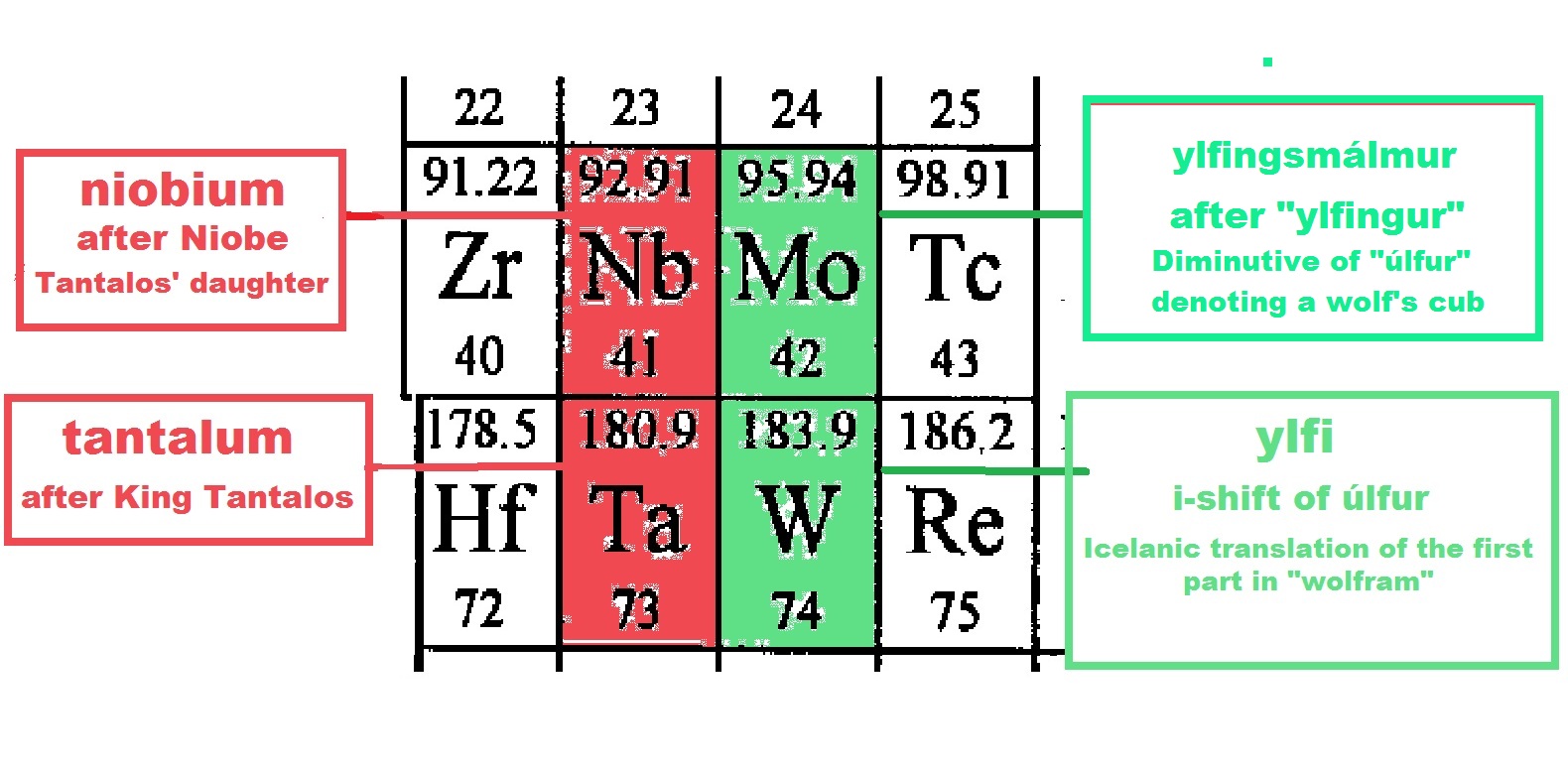
2) blýantylfi (pencil-wolfram): The people who lived near Knaben used molybdenite for pencils like graphite, which warrants the term "blýantylfi" (pencil-wolfram). For the second element ylfi, see Tungsten)
The term blýantylfi is equally long as molybdenum. It has the same amount of characters, same amount of syllables, while it refers to the right substance "ritblý" (literally "writing-lead", graphite) instead of a mere translation of the Greek molydos (lead).
The cabin hosts at Knaben Farm have, of course, always known they greyish, lustrous, pencil-like substance that is found there. Already in 1795 the Etatsråd Holm was on inspection, confirming that some good "blianterts" (graphite-ore) was to be found around the mountain. The substance was sold in the city in the form of pencils (Icel. blýantur) for the same price that you get for butter. It was discovered that the substance could serve as a lubricant for wagon wheels as well.
In 1810, Lieutenant Floor was on an "Economic trip" in Knaben on behalf of the Society for Development in the hope to ascertain that the substance was graphite. But two years later the report concluded that it simply was not graphite, but molybdenum, which had no commercial value". http://www.knaben.no/?vis=artikkel&magasin=&fid=4808&id=0408200815025528307&t=Historikk (first two paragraphs)
3) ritblendismálmur
Because molybdenite (MoS2) it is a "deceiving" sulphide mineral, which has the appearance of graphite but is a completely different substance), we can use the term ”blende” (Icelandic ”blendi”) as the second element in a compound-name for the mineral. The term ”blende” was derived from the German ”blenden” (deceive) and in its most original meaning denoted zinc blende or sphalerite (ZnS), which was thought to contain ”lead” but yielded none. This is the German wikipedia article about "blende". http://de.wikipedia.org/wiki/Blende_(Mineralogie). The term applies a thousand percent to molybdenite.
Molybdenum was first discovered in Knaben by the shepherds who saw something glistening in the sun on a rock. They took some of the substance home with them, and it turned out that they could write with it just like a pencil. This rock was called ”pencil mountain” (blýantsberget) What the shepherds found was most probably molybdenite. A Swedish chemist named Karl Wilhelm in 1778 showed that molybdenite consisted of molybdenum and sulphur. ( translation of : http://kurs.uia.no/iktl/studentprosjekter/inf105/2006/inf10508/html/knaben/gruvesamfunnet.html
Because molybdenite (MoS2) it is a "deceiving" sulphide mineral, which has the appearance of graphite but is a completely different substance), we can use the term ”blende” (Icelandic ”blendi”) as the second element in a compound-name for the mineral. The term ”blende” was derived from the German ”blenden” (deceive) and in its most original meaning denoted zinc blende or sphalerite (ZnS), which was thought to contain ”lead” but yielded none. This is the German wikipedia article about "blende". http://de.wikipedia.org/wiki/Blende_(Mineralogie). The term applies a thousand percent to molybdenite.
Molybdenum was first discovered in Knaben by the shepherds who saw something glistening in the sun on a rock. They took some of the substance home with them, and it turned out that they could write with it just like a pencil. This rock was called ”pencil mountain” (blýantsberget) What the shepherds found was most probably molybdenite. A Swedish chemist named Karl Wilhelm in 1778 showed that molybdenite consisted of molybdenum and sulphur. ( translation of : http://kurs.uia.no/iktl/studentprosjekter/inf105/2006/inf10508/html/knaben/gruvesamfunnet.html
see also http://www.mindat.org/loc-48314.html.
This is interesting: molybdenite was actually used as a pencil to write with , so instead of "ritblýsblendi" (graphite-blende), we can just call it ritblendi (the first 5 characters in "ritblendi" happen the same as in those in "ritblý", which is a very lucky convenience. So the meaning of ritblendi is: the deceiving sulphide mineral which was used instaed of real graphite to write with. This can only be a description of Molybdenite. So the name for the metal becomes: ritblendismálmur
4) léttylfi, ylfissystir (means "light wolfram" or "sister of wolfram (used "systur" to retain vocal-harmony, which is actually a Finnish grammatical feature)". Molybdenum is actually the softest metal of the chromium group. On Mohs' scale, chromium scores 8.5-9 (the hardest metallic element in nature, being almost as hard as corundum, the second hardest mineral after the diamond), molybdenum 5.5 and tungsten 7.5.
This is interesting: molybdenite was actually used as a pencil to write with , so instead of "ritblýsblendi" (graphite-blende), we can just call it ritblendi (the first 5 characters in "ritblendi" happen the same as in those in "ritblý", which is a very lucky convenience. So the meaning of ritblendi is: the deceiving sulphide mineral which was used instaed of real graphite to write with. This can only be a description of Molybdenite. So the name for the metal becomes: ritblendismálmur
4) léttylfi, ylfissystir (means "light wolfram" or "sister of wolfram (used "systur" to retain vocal-harmony, which is actually a Finnish grammatical feature)". Molybdenum is actually the softest metal of the chromium group. On Mohs' scale, chromium scores 8.5-9 (the hardest metallic element in nature, being almost as hard as corundum, the second hardest mineral after the diamond), molybdenum 5.5 and tungsten 7.5.
5) knefi (neuter-noun derived from Norwegian place-name Knaben, where the world's first dedicated molybdenum mine was situated):
The "Samlagets Norsk stadnamnleksikon mentions": Knaben, farm, busstop and post-town in Kvinesdal municipality, Vest-Agder. Originally a mountain name. The word knape (masc.) "rocky knoll" is very commonly used for for mountain peaks in Agder, both in compounds and on its own. Dilaectal variants are nape and nabbe (along the coast). (translation)
A. Torps etymologisk ordbog mentions for nape: A rocky knoll which protrudes from a surface. The word is related to the old Icelandic Knafahólar. (translation)
The Icelandic word for molybdenum could be the i-shift derivation of the first element in this name: knefi (neuter noun)
The "Samlagets Norsk stadnamnleksikon mentions": Knaben, farm, busstop and post-town in Kvinesdal municipality, Vest-Agder. Originally a mountain name. The word knape (masc.) "rocky knoll" is very commonly used for for mountain peaks in Agder, both in compounds and on its own. Dilaectal variants are nape and nabbe (along the coast). (translation)
A. Torps etymologisk ordbog mentions for nape: A rocky knoll which protrudes from a surface. The word is related to the old Icelandic Knafahólar. (translation)
The Icelandic word for molybdenum could be the i-shift derivation of the first element in this name: knefi (neuter noun)
13) technetium
1) gervisilfur: the artificially made metal on the period of silver
2) nýmálmynja (the new metalless (manganese), see manganese)
14) ruthenium
gerskaglit, gerskasilfur (The adjective"gerskur" refers to Gardaríki, which was situated in Ukraine, which is appropriate because the latinized form of Russia, Ruthenia was applied to the Ukraine see http://www.vanderkrogt.net/elements/element.php?sym=Ru This means the use of "gerskur" is 100% justified in this case.
14) rhodium
eðalsilfur (the noblest metal on the period of silver)
15) palladium
1) nýhvítgylli ("new white gold", "neoplantinum" because it is the homologue of platinum discovered later than its heavier brother)
2) svampsilfur, svampglit (sponge-silver, because it is located right left from silver and also because of its reputation as a "the metal sponge", which refers to the metal's unchallenged capacity to absorb an enormous amount of hydrogen gas. As it absorbs the hydrogen, it expands visibly, like a sponge swelling up when absorbing water.
http://www.chemicool.com/elements/palladium.html (key-word "sponge")
http://www.gold-eagle.com/gold_digest_00/dines030300.html
15) silfur
jarlsmálmur
A appropriate synonym for “silfur” would be: jarlmálmur (earl-metal). In the SnorraEdda the three highest ranks of nobility were successively: emperor (keisari), king (kóngur, konungur) and earl (jarl)
Maður er hver fyrir sér, Hið fyrsta og hið æðsta heiti manns er kallað keisari, því næst konungur, þar næst jarl. (Snorra Edda, skáldskaparmál, LXXIX)
The term jarl was also mentioned as a translation of “viceroy” in the Ensk-Íslensk orðabók með alfræðilegu ívafi, along with the synonymous undirkonungur.
From the viewpoint of modern chemistry, gold isn't the noblest metal in the sense of "corrosion resistance". With regard to this property, the honour is actually Iridium’s. Nevertheless, gold has always been seen as “the king of metals” and the metal "desired by kings" (especially Old Icelandic literature). Aqua regia (kóngavatn), the strongest acid was so-named because it dissolved “gold”. Silver, gold's lighter brother on the periodic table has always had the reputation of being the "second most noble of metals". This is expressed by the saying: "speaking is silver, silence is gold". These examples show that ‘jarlmálmur’ does well as an alternative designation for “silfur”.
Keisaramálmur (emperor-metal, Iridium) can only be the name for a metal that resists kóngavatn (aqua Regia), gull (gold) is the king and silfur (silver) the earl (jarl).
16) cadmium
blendissilfur: Blende in its narrowest and original meaning designates sphalerite or zinc blende Zn(Fe)S. This can be compared to the term "salt", which denotes in its narrowest meaning the compound NaCl. Now "zinc blende" or "blende" will always contain small concentrtions of zinc's heavier homologue cadmium. For that reason we can call cadmium "blendissilfur" (the homologue of zinc in the neighbourhood of silver)
17) hafnium
1) hafnarefni (Copenhagener, Hagener element), hafnarylfi (Copenhagener, Hagener wolfram): The second part in the Icelandic name for Copenhagen (höfn (genitive -hafnar) from Kaupmannahöfn) is sometimes used on its own in reference to the city: Hafnaríslendingar has been in use to refer to Icelanders who had settled in Copenhagen. The second element could be simply efni (element, -ium) or ylfi (wolfram, tungsten), a horizontal positioning marker to point to "heavy refractory metals" on near tungsten, which is the most well-known "heavy refractory metal")
2) danskmálmur, danaþungsteinn. It was Niels Bohr who prefered the name Danium above hafnium, but the latter term was ultimately chosen. http://elements.vanderkrogt.net/element.php?sym=hf
I personally like the term danaþungsteinn, because the element belongs, like tungsten to the so-called "refractory metals", a class of metallic elements that are extraordinarily resistant to heat and wear. Tungsten is a typical example and Hafnium and is situated only two places right from tungsten on the same period. See http://en.wikipedia.org/wiki/Refractory_metals
3) þungþyrsi (Titanium = þursamálmur, þyrsi, so þungþyrsi refers to the heaviest element in the titanium group, which is hafnium. The convenience of having "þungur" (heavy) as the first element in this compound lies in its alluding to "þungsteinn" (tungsten, wolfram), which is situated only two places right of hafnium and which belongs, like hafnium to the "heavy refractory metals" http://en.wikipedia.org/wiki/Refractory_metals
18) tantalum
1) kóngsylfi ("king's tungsten", "king's wolfram".)
The first element kóngur (king) refers to King Tantalos, after whom the element was named. Apart from that is tantalum's almost complete immunity to attack by acids and liquid metals. It equals glass in resistance to acids and it is impervious to liquid metals up to 1650°F. This makes the expression "royal tungsten" an appropriate choice.
For the second element ylfi, see Tungsten;
2) tálvonamálmur, tálvonaefni, tálvæni
Secod option is the use of the Icelandic translation of "tantalizations": tálvona- (from the Icelandic equivalent of the English verb "tantalize": kvelja með tálvonum and add málmur or efni. In this case, glit might better be avoided for it give rise to a confusion with glópagull, FeS (Fool's gold, an iron-compound that looks like gold but is worthless). A word like tálvonaglit would unfortunately be a perfect designation for fool's gold. Unfortunately, tálvonamálmur is inconveniently long and tálvonaefni is even a syllable longer. Of course you can reduce it to tálvæni, it has the initial "t" and two other consonants in "tantal", but you have to sacrifice transparency by omitting an element marker like -málmur, or -efni.
3) freyjuþungsteinn
A very interesting combination is freyjuþungsteinn. Tantalum is a member of the Vanadium group, named after its first member vanadium (named after Vanadís, a nick-name of the godess Freyja). The element belongs to the so-called 'Iron-group of transitional elements', so Freyjujárn was an obvious choice for Vanadium. Since Vanadium is the main and most abundant element of its group, the prefix freyju- could be used as a prefix to coin names for Niobium and Tantalum. In the case of Niobium, situated right below Vanadium on the period of silfur, freyjusilfur would be an obvious choice. Niobium is used in metal alloys for nonallergenic juwelry, which makes "silfur" as second element even more appropriate. And since tantalum is situated immediately left of tungsten, belonging to the so-called 7th period "refractory metals" (Hf, Ta, W, Re), freyjuþungsteinn couldn't be a more obvious a choice.
4) Compounds with þrá: þrámálmur, þráglit, þrávitisglit, eyþráglit, þráylfi:
Þrámálmur or þráglit could work. It is maybe an advantage that þrá- in compound can stand for 'desire' as well as "obstinateness". Tantalum is a "stubborn metal" in its being so chemically resistant to acids and þrá- can at the same time express Ekeberg's idea of "eternal unfulfilled desire". But then again: "þrámálmur" could be an alternative description for "gold", the metal desired by all.
Þrávíti (hell of desire and longing) is a nice name for the "penitentiary hereafter" king Tantalus was sent to would be"þrávíti" (hell of desire). I choose "glit" as a second element because tantalum is a lustrous metal and it is so acid-resistant that some chemists tend to see it as a seminoble metal.
5) fimbulylfi (fimbul- element of group 5B + ylfi (tungsten), the "tungsten" in group 5B)

20) tungsten
1) þungsteinn
2) ylfi
The neuter noun ylfi (i-shift of úlfur (wolf)) is a reduced Icelandic solution for the other name "wolfram" (or "volfram"), used for example in most European (especially Germanic and Slavic) languages. The name of the element is derived from the mineral wolframite, and this is also the origin of its chemical symbol, The name wolframite is derived from German "wolf rahm" ("wolf soot" or "wolf cream"), the name given to tungsten by Johan Gottschalk Wallerius in 1747. This, in turn, derives from Lupi spuma" the name Georg Agricola used for the element, which translates into English as "wolf's froth" or "cream" (the etymology is not entirely certain), and is a reference to the large amounts of tin consumed by the mineral during its extraction. This property of scheelite, wolvishly devouring tin in the smelter, can already be expressed by "úlfur" on its own, no need to add "ram" (froth). The shortest possible name, which is still transparent and flexible is the neuter noun ylfi, the i-shift derivation from úlfur (wolf), created in the same fashion as ildi (oxygen) from eldur (fire), vetni (hydrogen) from vatn (water), hyldi (nitrogen) from hold (flesh). One can compare this reduction of word-lenght to the construction of pet-forms of Icelandic personal names where only the first part of a compound name: Adda from Aðalheiður, Gunna from Guðrún. (see Tungsten).
2) baskamálmur, baskaglit: In 1783, José and Fausto Elhuyar succeeded in isolating tungsten and were credited with the discovery of the element. They were Basques, not Spaniards. So tungsten was a discovery of the Basque Country, not of Spain. For that reason It can be called Baskamálmur or Baskaglit. Read the following:
Elhuyar was founded in 1972 with the goal to promote the use of the Basque language in science and technology. In 2002, Elhuyar was turned into a foundation, out of which two companies developed: Elhuyar aholkuaritza and Eleka Ingeniaritza Linguistikoa. The latter is a company that offers services in the field of speech technology. The name Elhuyar originates from the two Basque brothers José and Fausto Elhuyar, who jointly discovered the element Wolfram, the most important discovery of the Basque country. (see http://www.mlta.uzh.ch/teaching/iw/iw-2012/EN_Baskenlandbericht-.pdf )

21) rhenium
1) torsuðumálmur, torsoði (The lustrous (noble) metal with the highest boiling point of ALL elements.
Rhenium is now known to have the highest boiling point of all metals and elements. Tungsten is known to have the highest melting point and was until recently thought to have the highest boiling point too, but no, that honour goes to rhenium
Tungsten 5555°C http://en.wikipedia.org/wiki/
Rhenium 5596°C http://en.wikipedia.org/wiki/
It's close win indeed, but still, a win. Sufficiently to found a term upon:
Rhenium belongs to the so-called refractory metals. See http://en.wikipedia.org/wiki/Refractory_metals . The Ensk-Íslensk orðabók með alfræðilegu ívafi mentions for the entry "refractory" as a metallurgical term: torbræddur, torunninn, the first one of which is typical for tungsten, which has the highest boiling point. This gives me confidence that starting the name of a refractory metal like rhenium with tor- is terminologically appropriate.
2) eðalþungsteinn: the element immediately left from tungsten that is included in the list noble metal. see http://en.wikipedia.org/wiki/File:Edelmetalle.jpg 3) rínylfi (A ompound of Rín- (Rhine) and ylfi (see tungsten)
The problem with this term is that rhenium, although situated right to the left of tungsten while sharing many physical properties with it in its capacity of being a refractory metal, it has nothing to do with the property of "devouring tin in the smelter", which gave rise to the name "wolfram" and my personal coning ylfi. Still, this doesn't have to be a deal-breaker. I believe we could use "ylfi" as a positioning marker for the heavier refractory metals neighbouring tungsten and of course as a second element in the name of its lighter homologue on the 5th period, molybdenum (linylfi, "soft tungsten")
4) þungmálmynja ("the heavy (natural) element in the manganese group". See http://en.wikipedia.org/wiki/Refractory_metals Manganese = málmynja, the female metal, because pyrolusite, the chief manganese ore was originally called "the female black stone of magnesia, where magnetite or magnetic iron ore, which occured allong with pyrolusite was considered to be the male counterpart). The term málmynja can be used for all four members of the manganese group of elements.

22) osmium
1) þefmálmur (The metal was named after the Greek osme meaning "a smell", because of the ashen and smoky smell of the volatile osmium tetroxide. The oxide forms already at room temperature, so the metal really stinks.)
2) blágull (differs from other platinum group elements and noble metals in general in that it possesses a distinct blue lustre. (see http://en.wikipedia.org/wiki/Osmium )

23) iridium
1) keisaramálmur (Iridium is the most corrosion-resistant metal known and isn't attacked by aqua regia (kóngavatn). In the Snorra Edda, the three highest ranks of nobility are: keisari, kóngur and then jarl). A metal that can resist the acid that dissolves gold, the king of metals is the "emperor metal".)
2) alvaldsglit (alvaldur, a king or god. This word could have been the perfect word for "emperor" in Icelandic, alvaldfreyja for empress)
3) hrapvottsgull, hrapvottsglit: Iridium is the "witness element" with regard to the extinction of the dinosaurs. This is no futile a property. The last element "gull" is here used in both a figurative sense of "very valuable substance" while it also alludes to its possition on the periodic table two places left from gold.
In Dutch a butte is called getuigeheuvel (witness-hill) so the idea of calling iridium a "witness substance" isn't that far fetched.
In 1980, a team of researchers led by Luis Alvarez, discovered that sedimentary layers found all over the world at the "Cretaceous–Paleogene boundary" contain a concentration of iridium hundreds of times greater than normal. Iridium is extremely rare in the Earth's crust because it is very dense, and therefore most of it sank into the Earth's core while the earth was still molten. http://en.wikipedia.org/wiki/Alvarez_hypothesis
On every rocky planet high concentrations of iridium will be "a witness of a meteor impact". This phenomenon is universal.

24) platinum
1) hvítagull (white-gold, the platinium metals could be called hvítgyllingar)
2) silfringur (The spanish platina is a diminutive of 'plata' (silfur), the icelandic equivalent would be "silfringur". The platinum metals as a group could be called silfringar.
25) gull
26 kvikasilfur


