Saturday, August 4, 2012

Radioactive elements

Polonium
1) maríublý,
Polonium is situated just two places to the right of lead (blý) and most of its exceedingly radioactive isotopes represent one of the last stages in the three major decay-chains that end up with lead-isotopes. This makes blý an appropriate choice for a second element in a compound. As for the first part: because the element was discovered by Marie Curie, who named it after her country Poland, it would be appropriate to name it after her.
2) Læsamálmur, Læsynjublý, Læsaefni, Læsablý: The first part of this compound is an Old Icelandic name for the Polish people: Læsir (masculin plural of Læsur). The Íslensk orðsifjabók mentions:
3 Læsir, Lḝsir, Lesir k.ft. † pólskur þjóðflokkur við Vislu, Ljachar, sbr. frúss ljachy 'Pólverjar', lith. lénkas og fpól. lęchь (s.m.) sem er samdráttarmynd (með smækkunarviðsk. -ch) < lędĕninь af lędo 'nýtt land, óbrotið land', eiginl. 'nýlendingar'. Sk. land
Marie Curie was born in Warsaw, which is situated at the Vistula River, so Læsur applies to her, Læsynja, the feminine form of Læsur is even more specific: Læsynjumálmur, Læsynjublý (metal, lead of the Polish woman)
In the early 11th century, Scandinavians referred to the Polish tribe of Polans in the region of Gniezno as Laesar. (see http://en.wikipedia.org/wiki/Lendians and http://en.wikipedia.org/wiki/Polans_(western)

Note that the typically Polish name Lech, which is the first name of the former Polish president Lech Walęnsa, happens to have an Icelandic variant!
The term Lechitic is related to the name of the legendary Polish forefather Lech and the name Lechia by which Poland was formerly sometimes known. http://en.wikipedia.org/wiki/Lechitic_languages
The orðsifjabók also mentions Læsir as a masculine personal name, which is identical to Lech, so Icelandic actually has a form of its own for this typically Polish name: Læsir Valensa (Lech Walęsa, in which the normally nasal sound ę is colloquially pronounced as 'en', so I adapted it to Icelandic as 'en'.

1) Læsir, †Lęsir k. † karlmannsnafn (í fornaldars.) Vísast tengt þjóðflokksheitinu Læsir (3) Íslensk orðsifjabók (see above)

3) púlín, púlínablý, púlínamálmur
If the word has to be constructed in the same style as most other names, where the ending -ium is replaced by -ín (natrín, kalín, kalsín, why not calling polonium PÚLÍN, instead of 'pólon', after the oldest Icelandic form Púlínaland, mentioned in the Þiðreks saga af Bern: En er Vilkinus konungr hefir stýrt þessu ríki um stund, þá býr hann her sinn ok ríðr með ótal riddara ok annarra hermanna út í Púlínaland ok á þar margar orrostur ok stórar bæði.
 
astatine
1) valtsöltungur, valtselti, stundarselti (the unstable halogen)
2) birkilselti, birkilþengi ("Berkelian" halogen, "Berkelian" iodine, the halogene synthesized and characterized in Berkeley. For the explanation about the derivations birkil-, -birkli, Birkiló see http://lotukerfi.blogspot.be/2012/08/polonium-mariubly-pulinamalmur-ok-that.html (under Berkelium)
3) skildilbirkli (literally "thyroberkeline", Astatine, similarly to its stable and lighter brother iodine will, most characteristicly, accumulate in the thyroid gland. The authors of the iðorðasafn lækna were apparently satisfied with stem-compound constructions with the monosyllabic skjald- (stem of skjöldur, shield), instead of dissyllabic constructions with skildil- (skildill, thyroid gland) in terms refering to the thyoid gland: e.g. skjaldeitrunar- (thyrotoxic), skjaldsarpur (thyroid crisis). So we can use skjald- as the first element in an Icelandic compound-name for astatine.
Although astatine occurs in nature in extremely small amounts, the elusive halogen was first characterized after its creation by bombardement of bismuth with alpha particles in the Berkeley labs. In English terminology berkeline would have been equally valid a name for this element because only halogens have the -ine ending and only astatine was made at the Berkeley labs.  For that reason -birkli can be used as second element. It is a neuter noun I use as a suffix in some names of elements syntesized in Berkeley, e.g. berkelium, birkilbly, birkli and Curium, maríubirkli (marie-berkelium), the element preceding berkelium and named after Marie and Pierre Curie. The resulting compound skjaldbirkli, would, literally translated into English be something like THYROBERKELINE (thyro- (suffix refering to the thyroid gland) + berkel- (from Berkeley, as in Berkel-ium) + -ine (the suffix used in names for halogens: fluorine, chlorine, bromine, iodine and astatine). For the explanation about the derivations birkil-, -birkli, Birkiló see http://lotukerfi.blogspot.be/2012/08/polonium-mariubly-pulinamalmur-ok-that.html (under Berkelium)
4) óst (from óstöðugur, meaning "unstable". This adjective is, as luck would have it, etymologically related and still sound-similar to its Greek equivalent άστατος (astatos).)


Radon
1) geislaloft (Mentioned in the iðorðasafn lækna (English - Icelandic medical terminology) as the equivalent of "emanation", which is actually the obsolete name for this noble gas.
þórsloft = thoron
þórálsloft, hnossarloft = actinon
maríuloft, þrúðarloft = radon)
2) útloft (lit. "ultron", "exogas", "exon")
3) blyfti ("plumbon", "lead-heavy air", a contraction of blý (lead) and lyfti (i-shift of loft, which exists, unfortunately already as a name for nitrogen, but it has failed as a neologism in favour of nitur, so doesn't have to be a deal-breaker). Blyfti is a kind of "terminologically reductionist short-cut" of blýþungt loft (lead-heavy air).


Francium
stundarmálmur (The element's most stable isotope has a half-life of no more than 22 minutes, that means that one eighth part of it is still there after an hour, so the compound stundarmálmur, with the first part "stund", interpreted in an additional sense of "klukkustund" (hour), is applicable in this case.)


Radium
1) maríuglóð
Radium was discovered by Marie Curie (maríu-) and is so intensely radioactive that it glows in the dark (-glóð). In English, the literally translated equivalent of this neologism would be "mariglow" (constructed like "marigold").
2) þrúðarblý, þrúðarmálmur, þrýði
The daughter of Þór was called Þrúður (equivalent with -trude in the German name Gertrude) and all direct "daughter products" of thorium are "radium isotopes". Imagine the Swedish chemist Jöns Jakob Berzelius being abducted by time-travellers, who enabled him to make acquantance with the Curies and their discovery 50 years after his death, is it unthinkable that he would have advised the couple to baptize the newbie "trudium" to retain the connection with his thorium? Quite a few element were named after mythological characters: think of vanadium, titanium, tantalum, tellurium or niobium. This way of name-giving is completely in line with historical terminology trends with regard to the discovery of elements. 
The names for radium I propose are: þrúðarblý, þrúðarmálmur or even þrúðarefni.  We can even create an i-shift of this feminine personal name: þrýði (compare vatn -vetni (H), eldur -ildi (O), loft -lyfti (N)).  This would be a very short and flexible name and has the same lenght as the existing radín, there are no connotations, it doesn't yet exist as an entry in the ritmálssafn orðabókar háskólans. The i-shift exists only in the obsolete personal name Þrý(ð)rekr (Íslensk orðsifjabók).
3) þórkelki (lit. "thorian calcium", a name composed of two positioning markers that position the element crosswise: þór- is the periodical positioning prefix, which situates radium (nr. 88) in the neighbourhood of thorium (nr. 90), while -kelki (calcium, an i-shift of kalk, "limestone") places the element in the group of earth alkaline metals.  The neologism 'kelki' (calcium) is an i-shift derivation of 'kalk' , like vetni (hydrogen) is derived from vatn or ildi (oxygen) from eldur (fire).  I wasn't sure whether the construction would sound OK in Icelandic ears. Maybe it could lead to inconvenient connotations with derivations from the verb kelkja: þrákelkinn, kelkingur, ect. Fortunately, I found a reassuring example in the iðorðasafn lækna (Icelandic medical terminology list): kelkill, a shorter synonym for kalkkirtill ("parathyroid gland", the gland that regulates calcium metabolism). If "kelkill" is acceptable in the eyes of Icelandic neologists, then there shouldn't be a problem with "kelki" for "calcium".
Og hvernig skall kenna maríuglóð? Svo að kalla þrúðarblý eða þrýði, og líkn þórkelki og móðir blýþungs lofts eða blyftisgjafa (nuclear physics terminology in an eddaic dress!)

Note that the radium that was found by the Curies was mostly Ra-226, the most stable isotope, which is a daughter-product of Ionium or Thorium-230 (bikþór, see thorium), which ultimately goes back to the parent isotope U-238, the most abundant source of which is uraninite or pitch-blende.  So bikþrýði "pitch-trudium" specifically designates Ra-226.

Actinides
Þórbirklingar (thorberkelians)
The first element Þor (þór-) refers to Thorium, which is the most abundant of the natural actinides, three times more abundant than uranium, in the same way as Cerium, its homolog in the lanthanide series is the most abundant of the lanthanides. that's why the first 7 lanthanides, including lanthanum, are called "ceroids". "Þór-" as a first element in a collective name for the actinides refers to the first naturally occuring actinides.
The transuranium actinides, from Neptunium to lawrencium were discovered in Berkeley labs.  Neptunium and plutonium were later discovered in nature but the transplutonium elements were all synthesized at Berkeley.  This place-name most easily translates as Birkiló (Birch-clearing) and birkil- can be used in constructions like birkilefni (compare berkel-ium) or nýbirkilefni, nýbirkli (californium), maríubirkli (Mary's berkelium, curium).  The second element in the name for the actinides, representing the transplutonium elements is -birklingar.  This sounds like the collective family name derived from a man called "Bjarki Þór", so it sounds truly Icelandic.


Actinium

1) útþribblingur: Scandium = þribbill (first element of group 3B, þrír (three) + BB +-ill (in a diminutive because it is the lightest member), the þribblingar stands for the elements in group 3B, the Scandoids, if you like), so finally útþribblingur (út = outer, exo- + þribblingur (member of group 3B stand for actinium)
2) þórál
The "aluminium" next to thorium' (Aluminium can used here in the sense of "trivalent chemical element" for all element in the groups 3A and 3B, because it happens to be the primordial and most abundant trivalent metallic element in the universe and the first of its kind (boron is not a metal) on the periodic table. The first element 'þór-' refers to its closest actinide brother situated right next to it on the periodic table, the relatively superstable thorium.
3) hnossarblý
Protactinium has a stable V+ oxidantion state and is therefore a "pseudohomologue" of elements of the Vanadium group.  It is the periodic table's first and probably last "pseudovanadoid". This means that freyjublý (blý) (from freyjujárn, vanadium) can be used  to denote its position).  The daughter of the godess Freyja was called Hnoss, so hnossarblý becomes the name for Actinium.

Thorium
1) þórefni, þórblý
2) eyblý, eyjublý (island-lead): This term is, firstly, founded upon the fact that thorium was discovered in a sample that originated from the Norwegian island Løvøy (Icel. Laufey), see http://en.wikipedia.org/wiki/L%C3%B8v%C3%B8ya,_Telemark and secondly and maybe more importantly, the fact of thorium being the most stable and consequently most abundant element of the two only islands of nuclear stability beyond lead and bismuth: thorium (eyjublý) and uranium (úteyjublý). Plutonium is útskersblý (útsker = outer sea-rock).
3) Norðblý (= Norwegian lead. The only postplumbic element that is named after something Scandinavian)

Ionium or thorium-230
bikþórblý (pitch-thorlead) or simply bikþór (holtaþór is an Old Icelandic name for quartz, so why can't names of metals or stones end simply in -þór, something that is also commonly seen in Icelandic personal names like Hafþór, Álfþór,...)
Thorium-230 is formed as a decay product of Th-234, which is in its turn a daughter-product of U-238.  so it found in pitch-blende (here expressed by the marker bik-, from bikblendi), while thorium's most abundant isotope Th-232 is not.  So bikþór (pitch-thor) is the name for this isotope.  See also radium.

Proactinium
1) eyjasundsblý (eyjasund means "sea-strait between islands" and occurs thrice in the Old Icelandic dictionary:

Eyjasund, n. a sound or narrow strait between two islands, Egils saga. 93, Formanna sögur ii.64, 298. (Cleasby, Vígfússon, Craigie, An Icelandic-English Dictionary)

The term "eyjasundsblý" refers to the position of the unstable and relatively very underabundant protactinium, sandwiched between the only two island-elements in the postplumbic (after lead) "sea of instability": thorium and uranium, the half-lives of which are sufficiently long for them to have survived the gigayears of geological time and to be still present in nature in significant quantities. The last element blý is used in reference to the position of protactinium after lead and also to the fact Pa-231, which constitutes almost 100% of all crustal protactinium, ultimately end up as the lead isotope Pb-207. 
If you compare the periodic system with landmasses as is done in superheavy element chemistry (see http://en.wikipedia.org/wiki/Island_of_stability (see paragraph "island of relative stability"), protactinium represents the sea-strait between the only two postplumbic islands of stability, thorium and uranium.  Strictly spoken, eyjasundsblý is more robust in its correctness than the name protactinium itself, because not all protactinium-isotopes decay into actinium.  It's somewhat similar to naming helium "alphium" after the overabundant He-4 isotope, while ignoring the existence of trialphium or He-3.  Eyjusundsblý doesn't have flaws. The name is founded upon the fact that protactinium will always remain,  astro- and geochemically, the ONLY element that constitutes the ONLY "sea-strait of instability". an additioonal bonus is the fact that "eyjasund" is a lexical artefact from the Old Icelandic literature occuring in the Egilssaga and the Formannasögur.
A last point: One may ask: And what about neptunium, which is situated between uranium and plutonium. The latter can still to be found in very small trace-quantities in nature. Doesn't that make neptunium qualify as a "sea-strait" between relatively stable islands in the same way as protactinium between thorium and uranium?  No, actually not.  A term like eyjasundsblý for neptunium would be like naming the water between the Icelandic island Grímsey and the tiny sea-rock further up north, a sea-strait.  For non-icelanders: would it be practical to call the space between Ireland and the tiny westernmost sea-rock Rockall, a sea strait?  No, from a geographer's viewpoint, the water north of Grímsey or north-west of Ireland is "open sea", with of course small islands, like St-Kilda or sea-rocks, like Rockall or in the case of Iceland, Kolbeinsey. But calling the space between two landmasses, that differ more than a 100,000-fold in size, a strait, seems to me too far a fetch, impractical and actually, from a geographer's standpoint, irrelevant.  And this is exactly the situation of Plutonium in the postplumbic sea of instability with regards to the nuclear stability of its isotopes and the extrapolating effect of this on their abundances. Plutonium is like the small sea-rock Rockall in proportion to the islands England and Ireland (thorium and uranium respectively) http://en.wikipedia.org/wiki/Rockall.  Europe could be regarded as the elemental continent ending at bismuth (Cape Griz Nez near Calais  http://en.wikipedia.org/wiki/Cap_Gris_Nez . But the straight of Dover had better been a few thousand kilometres wider to suit this comparison, but you see what I mean.  The term útskersblý (outer + sea-rock +lead) would therefore make a nice term for plutonium.  So there's no reason to think of neptunium as a sea-straight. That honour exclusively goes to protactinium.
.
2) þórálsmóðir (þórál = actinium)
(proto- (for-) + þórál (actinium, "thor-aluminium", the element in the immediate neighbourhood of thorium, which is chemically the closest in its properties to aluminium), because the longest-lived protactinium isotope desintegrates into an isotope of actinium).
3) freyjublý, vanynjublý (waness' lead), vanskablý (wanish lead)
Protactinium has a stable V+ oxidantion state and is therefore a "pseudohomologue" of elements of the Vanadium group, designated with the marker Freyju- (Vanadís). It is true that there is no reference to the pseudohomolgue nature, but the addition of -blý (lead), which is used as a positioning marker of elements from lead to the higher region of the actinide series, excludes tantalum or seaborgium.
4) sýndarsúrjarðarmálmur, sýndarsúrjörðungur (pseudo acidic-earth-metal), súrjarðarái ("acidic earth forefather", refering to its position as a "vice parent isotope", successing U-235, in the actinium decay chain), súrjarðarþórsblý (acidic earth thor-lead, thorium),
This is another avenue of thought in the translation of protactinium: sýndar- "pseudo-" + súrjarðar "acidic earth", which is coined after the old German term erdsäuren or säure erden, which specifically designated the pronounced acidic mineral oxides of the members of the Vanadium group, V, Nb and Ta, see http://de.wikipedia.org/wiki/Erds%C3%A4uren
Protactinium is the only element that is pseudohomologuous with elements of the vanadium group in possessing a stable V+ oxidation state. Protactinium's brother in the lanthanide series, praseodymium, doesn't have this V+ state.


Uranium
1) úteyjablý ("útblý" would be erroneous in its insufficiency, for it can as well denote bismuth, at the shore of the "sea of nuclear instability". The first part úteyju means " of the outer islands", which refer to U-235 and U-238). The second part -blý incdicates its position after lead and that after a long time the element will end up as "lead".
The first part in "úteyja-", út (outer, outlying), refers to the fact that the predominant uranium isotopes U-235 and U-238, represent the last significant "isotopal islands" of stability. The primordial Pu-244 (útskerssamsætan, the "outskerry" isotope) with its half-life of 80 million years just managed to survive the onslaught of geological time enough to still be around in very small trace amounts, so Plutonium hardly qualifies as an "ISLAND of stability", it should rather be regarded as an "útsker" (outskerry) like Kolbeinsey, north of Iceland or Rockall in the Atlantic.


2) fenrisblý: The reason hy I think this is the best option:
a) Fenrir in the compound fenrismálmur (fenrismetal) somewhat refers to the pseudohomologous and hexavalent "wolfram", the element named after the voracity of wolfram ore in the smelter, where it devoured tin. Fenrir is the biggest of all wolfs like uranium is the heaviest of the sufficiently stable elements after lead that allows them to still be existent in the earth's crust in significant quantities after 5 gigayears of geological time. The substance used for uranium enrichment to produce the first nuclear weapon back in 1945 was the corrosive, wolvishly voracious UF6 uranium hexafluoride in which uranium is hexavalent, the typical "wolfram" oxidation state!
b) the second element blý situates the element beyond lead, which it will ultimately turn into after billions of years of slow decay
c) Fenrir was the "doomsday wolf" of Nordic mythology and the first real doomsday-weapon in modern times was the uranium-235 bomb on Hiroshima. General Douglas McArtur used the word "doomsday" in reference to future warfare after Japan had surrendered. In the same way as wolf Fenris lied chained until he broke free from his fetter at the "end of days", uranium had been locked, chemically bonded by oxygen in pitchblende for aeons until mankind freed it from its ore to unleash it hidden, apocalyptic powers.  This is why a confusion with plutonium is impossible in this case.  Uranium lied hidden in substantial quantities and all plutonium (e.g. for the Nagasaki bomb) was created by neutron bombardement of U-238.  Plutonium in nature isn't found in sufficient quantities to be sufficiently exploited.  That's why fenrisblý applies to uranium and not to plutonium.
d) Fenrir was fettered on the island lyngvi (U-235 is the fissionable of the three isotopal "islands of stability" after lead and bismuth).
e) Fenrir or his sons (this is disputed) swallowed the sun which created total "pitchblende-black" darkness (could be seen as a reference to a nuclear winter, as the darkness after a nuclear war is called)

We can create two different compounds here: Fenrismálmur (blý isn't required here as the last element because most infomation is packed into the first element: doomsday (first hiroshima bomb, the swallowing of the sun (nuclear winter)), wolvishness (link with pseudohomolog wolfram, the wolvishness of wolfram lies in the fact that UF6, the compound used to purify U235 for the first atom bomb, was hard to handle and devoured everything in its way) and úlfblý is a shorter way of expressing the idea, but here we need -blý as the second element.

3) þórþungsteinn (thor-tungsten, thor-wolfram)

The peculiar arrangement of the first 5 actinides in some older representations of the periodic table with a shifted position with respect to the other actinides reflects the fact that, owing to a large delocalization of their 5f orbitals, the 5f electrons take part in their chemistry, a feature that is much less pronounced in the 4f series of the lanthanides. This makes Th a pseudohomolog of the group 4 elements Zr and Hf, Pa a pseudohomolog of the group 5 elements Nb and Ta, and, to a lesser extent U (Uranium) a pseudohomolog of W (Tungsten). The more uniform actinide behavior is found only with the latter half of the actinide elements beginning with Am (americium). Because of this chemical similarity between uranium (U) and tungsten (W), I decided to call the first “þórþungsteinn” (þór- referring to uranium’s proximity to thorium (þórblý, thurslead), its much more abundant and sole relatively stable actinide relative.  The second part þungsteinn reflect the pseudohomologous similarity to tungsten (W). 
Despite of the PSEUDOhomologuous nature, I don't think it's inappropriate to make use "tungsten" in the creation of a native Icelandic name for uranium. Old names of metals that exist since the invention of metallurgy, like tin, silver, gold, are sometimes used in compound to denote elements with even very different  chemical properties. Names like "astin" (ash-tin), a synonym of bismut in Dutch in which the second element "tin" only refers to the metal's lustre, or "white-gold" (hvítagull) for platinum, which is chemcally less homologous with gold than uranium is with tungsten. "thurstungsten" (Thurs- from Thursday, Thor's day) only refer to an element near Thorium that, albeit pseudohomologeously, displays chemical properties similar to tungsten.
"Þórþungstein" (thurstungsten, ) consist of three Old Icelandic words and has only three syllables, which compensate for the amount of characters. 
4) áablý, áamálmur
The only way to coin native names for elements higher than lead and bismuth is to make use of "blý" (lead) as a terminological positioning marker on the periodic table.  Most isotopes of elements heavier than lead and bismuth are radioactive and will eventually (provided they don't desintegrate through the process of spontaneous fission, which exceeds alpha-decay as the predominant mode of fission in transcalifornium elements) end up as "lead-isotopes". This is another reason to use 'lead' (blý) as a second element in compounds, apart from its utility as a positioning marker for transplumbic elements.
The only two elements, heavier than lead and bismuth, that have isotopes sufficiently stable to have been able to survive geological timescales are Thorium (Th, þórsblý), specifically its isotope Th-232 and Uranium (U-235 and U- 238).  My first though was to first use the collective term paleoplumbum (Icelandic: frumblý) to designate these three isotopes and then to further differentiate between the elements themselves by means of a prefix. The problem with paleoplumbum, unfortunately, is its suggesting that all the lead in the universe results from radioactive decay, which is not the case.  The largest proportion of the lead wasn't enriched further into heavier elements in the neutron absorption process in supernovae due to the enormous stability and neutron-absorption-resistent nature of some lead nuclei.  For that reason, I choose áably (ái (great-grand father, forefather, progenitor) + blý (lead)).  These words only refer to the heavier elements that decay into lead and doesn't say anything about the different origins of the lead in the universe.
Now, in strict sense, áablý or eddublý refers to the three existing parent isotopes Th-232, U-235 and U-238, but I decided to use áablý exclusively for uranium.  The reason for this is because Uranium was named after the planet Uranus, which in its turn was named after the original forefather of the Greek Gods, the "ái" of the Olympians, comparable to Buri, Odin's grandfather and progenitor of all gods in Scandinavian mythology. The god Thor, after whom the element thorium was named, didn't possess this ability of being a "theoprogenitor" (áaguð, áaguðsstjarna (planet Uranus)). The second and third reason is because uranium is the heaviest of both elements and posseses two of the three parent isotopes.
5) frumguðsblý: The metal was named after the Planet Uranus, which was in it's turn named after the forefather of all olympian gods, the theoprogenitor Uranus: frumguðsstajrna (the "theoprogenitor star", the planet uranus), frumguðsblý ("theoprogenitor lead", uranium). There are many theoprogenitors in different mythologies, but all planets are called after Greek and Roman Deities there is only one star and undirectly one element that actually bear the name of a "primordial god", so we don't have to specify here.  The prefix frumguðs- (theoprogenitor) can perfectly replace "uranus" in these cases. The inclusion of "stjarna" (star) is not obligatory, also because frumguðsstajrnablý would be too long.  All references to Uranus, being it to a god or a star could be made by using frumguðs-.  Some mention Aether or Chaos as the father of Uranus, but most Greeks considered Uranus to be primordial and gave him no parentage. (see http://en.wikipedia.org/wiki/Uranus_(mythology)  under the paragraph "genealogy".
6) bikmálmur
The word "pitchblende" is also called uranpecherz in German, but in Dutch the word "pekerts" also exists.  In Czech, it is named smolinec, derived from "smola" (pitch, tar), which again doesn't contain the word "blende". Any mineralogist will point to uraninite when you talk about the "pitch-ore", so we don't have to make use of "blende" when creating a native name for uranium.
So how do we form the Icelandic name then?  First we translate "pitch-ore": bik (pitch) + málmgrýti (málmur (metal) + grýti (mineral)): bikmálmgrýti, from which we can derive "bikmálmur" (pitch-metal).
7) dulkraftsblý (dulkraftur (hidden power) + blý (lead))

Hvernig skal kenna úlfblý? Svo að kalla því úteyjublý, fenrismálmur, jaðarylfi, þórþungsteinn, bikmálmur, dulkraftsblý og líka áablý eða frumguðsblý.

Neptunium

1) A name based upon the name of neptunium's homolog promethium in the lanthanide series

a) eldþjófsblý: The name of uranium's periodical successor could be founded upon the Icelandic name of its lighter lanthanide brother promethium (eldþjòfsmálmur) see http://lotukerfi.blogspot.be/2012/08/rare-earth-elements-hulismalmar.html  The last element -blý ositiones the element after lead: eldþjófsblý (fire-thief-lead)
This way of creating names of actinides isn't uncommon. compare: europium - americium/ gadolinium - curium.
b) þeif(s)blý: "-þeifur" is an abbreviation of Prómeþeifur which sounds like "þjófur". This is no more a morphological mutilation of a word than the element names erbium, terbium or yttrium, which are element names generated from decapitated left-overs of the Swedish place-name Ytterby
c) birkilþeifi (Neptunium was discovered at Berkeley (Icel. Birkiló, Birkil- (like Berkel- in Berkelium)) + þeifi (neuter form of -þeifur (from Promeþeifur (Prometheus), after which neptunium's homolog in the lanthanide series was called). "Birkilþeifi" (Berkelian promethium) emphasizes that Neptunium was discovered at the Berkeley labs instead of the Oak Ridge labs, where promethium was found.

2) A name based upon the name of Nordic equivalents of the Roman sea-god's: Ægir and
Njörður

Ægisefni, ægisblý/ njarðarblý, njarðblý (Ægir/ Njörð are the Nordic equivalents of the Roman sea-god Neptune.)

Plutonium
1) sjögervisblý, flókinmálmur (Plutonium is an actinide element located at the transition where the 5f electrons go from being delocalized to localized, which makes it one of the most complex materials known. It has as many as seven allotropic (Icelandic: fjölgervi) forms, which means that it exists in seven different forms. 
I like this word because "seven" is the magic number of fairy tales and "hell" which is associated with "plutonium" (see next term) has been depicted as having "seven gates".
http://en.wikipedia.org/wiki/Plutonium (See under: electronic structure)
See http://physicsworld.com/cws/article/news/2002/nov/20/plutonium-is-also-a-superconductor
http://www.lanl.gov/newsroom/news-releases/2012/May/05.21-plutonium-fingerprinted.php
2) heljarblý (Because it is often refered to as "the infernal element". http://ftvdb.bfi.org.uk/sift/title/243165?view=synopsis I choose a compound with -blý, used for elements heavier than lead of which the majority of their isotopes decays into lead-iostopes.)
3) kleyfagull (lit. "the fissile gold", from adj. kleyfur (fissile) + gull (= gold, in the sense of valuable substance, as in the expression "black gold" (petroleum).  Plutonium has been the most important element in nuclear industry. Uranium was known before the nuclear era and it would therefore be somewhat "terminologically anachronistic" to call it explicitely after its later discovered nuclear properties, while plutonium was the first elemental fruit, if we may call it so, of the "nuclear era".

4) útskersblý, útskersefni: Plutonium is the outer sea-rock, the "Rockall" or "Kolbeinsey" of the postplumbic "sea of instability", in comparison to which Ireland compares to uranium, Great Britain to Thorium and the European mainland to the continent of stable elements which end at bismuth-209, which could be compared to Cape Griz Nez in France at the strait of Dover, and this is a bit unfortunate because the "mainland of nuclear stability" and the first large island thorium is no narrow strait, there are 6 elements between bismuth and thorium, so here the comparison is flawed, but you'll understand the point I want to make. http://en.wikipedia.org/wiki/Rockall
Útskersblý means "outer sea-rock lead" and refers to the element's outermost position on the periodic table as a "naturally occuring" element. At the same time if refers to its very low abundance, in comparison with thorium and uranium, which are like the British Islands in comparison.
This, again, is another example of terminology founded upon the geographical presentation of postplumbic elements. In physics it is called "sea of instability”, which starts at bismuth, the "fore-shore element" (fjörublý), because it is now known that bismuth-209 is radioactive, but its half-life is a billion times longer than the age of the universe. For that reason it is comparable to what Icelanders call fjara, which translates as "fore-shore" or the part of the beach between the ebb- and the floodline. Personally I disfavour a term like this in the case of bismuth because it would constitute a terminological anachronism. The metal was known long before the almost infinitely small instability of its predominant isotope Bi-209was established. Alternatively naming Francium djúpálefni ("deap-sea trench element") is in this respect more appropriate because the knowledge about radioactive elements at the time of francium's discovery was sufficient for this term to be conceived. Francium is the most unstable of the first 106 elements and when its low atomic number is taken into account, it is the most unstable element that will ever exist, therefore djúpálefni. Thorium and uranium could respectively be referred to as eyjublý (island-lead, not only because it constitutes the most important island of stability on the periodic table but also due to the fact that thorium was discovered in a sample that originated from the Norwegian island Løvøy (Icel. Laufey), see http://en.wikipedia.org/wiki/L%C3%B8v%C3%B8ya,_Telemark ) and of course úteyjublý (outer island lead) for uranium. But again, these two latter terms are founded upon knowlegde generated long after the discovery of these two elements. The name eyjusundsblý for protactinium, the element between the two latter, on the other hand, is fabulous and in line with the knowledge that existed at the time it was discovered.  And of course útskersblý for plutonium is doable.   

Th-232 (thorium), U-235 and U-238 (uranium) are the only naturally occurring isotopes beyond bismuth that are relatively stable over the current lifespan of the universe. Bismuth was found to be unstable in 2003, with an α-emission half-life of 1.9×10¹⁹ years for Bi-209. All other isotopes beyond bismuth are relatively or very unstable. So the main periodic table ends there (by geographical analogy, the shore edge of a continent; a continental shelf continues however, with shallows beginning at radium that rapidly drop off again after californium, with significant islands at thorium and uranium, as well as minor ones at e.g. plutonium, all of which is surrounded by a "sea of instability", which renders such elements as astatine, radon, and francium extremely short-lived relative to all but the heaviest elements found so far.
http://en.wikipedia.org/wiki/Island_of_stability
  

Og hvernig skal heljarblý kenna?  Svo að kalla sjögervisblý eða flókinmálm og líka kleyfagull. Málmurinn er gert úr fenrisblýi

Americium
nýheimsblý: ("New-world"-lead). The addition bly is used to position postplumbic elements.  The longest-lived isotope Am-243, as an alpha-emitter ends up as Pb-207.


Curium
1) hjónamálmur: the "married couple" metal.  Curium was named after Pierre and Marie Curie and is the only element named after a couple.  The curies are also the most well-known couple in the history of science.
2) maríubirkli: The first element maríu- refers to Marie Curie and the second -birkli is a reduced form of birkilblý, birkilefni (which is in its turn a reduction birkilóarblý, birkilóarefni, berkelium, the next element after curium), see Berkelium.

 
Berkelium
1) birkilóarblý, birkilóarefni (This artificially made transuranium element was named after Berkeley, which means 'Birch-tree wood or clearing', from the Old English beorc and leah, the Icelandic equivalents of which are björk (bjark- , bjarkar-, birki- in compounds) and 'ló': 'Birkiló'.
2) birkilefni, birkli: But why not reduce the construction birkilóar- to birki- or maybe even better, birkil-, like berkel- in berkelium? The term berkelium was composed of berkel- (from Berkeley) by dropping the final consonant -ey in ley, with addition of the elemental suffix -ium. In the same way, we could omit the final ó in -ló and use birkil- as a terminological building block. This is hardly to be called a corruption knwoing that many English toponyms ending in -ley, -leigh, -ly underwent a similar change.

Crowle (Worchestershire) pronounced: [koul], derived from Crohlea. ‘Woodland clearing by the nook or corner’, Old English cróh (nook of land) + léah (clearing, Icelandic ló).
Keevil (Wiltshire), pronounced: ['ki:v(i)l], derived from Chivele (1086, Domesday Book), probably derived from Old English cýf (hollow) + léah (clearing).
Other examples are: Marcle, Ocle, Scarle, Sporle, Worle. (See: Oxford dictionary of English place-names).
Judging from these examples, the toponym Berkeley could have easily evolved into something like "Berkle".

The even shorter form birkli (from birkil-) could serve well as a second element in Icelandic names of other transuranium elements, neighbouring berkelium, like maríubirkli (curium, the element preceding berkelium). The transuranium elements from Neptunium (93) to seaborgium (106) were synthesized at Berkeley, before some of the lightest among them were discovered in nature.  There's no reason why all transuranium elements, even those beyond seaborgium (Icel. birkilþungsteinn) couldn't be denoted by the collective term Birklingar, even the ones after Seaborgium. From a historical point of view, this collective term is perfectly justifiable.

Californium
1) nýbirkilefni, nýbirkilmálmur, nýbirkli (new berkelian metal, neoberkelium). Californium (Cf nr. 98) was synthesized in 1950, a year after berkelium (Bk nr. 97) and two years before einsteinium (Es nr.99).  Of all elements, only two were named after California and a place in California, Berkeley: Berkelium and its slightly heavier immediate neighbour californium, so the name-giving birkilefni (Bk) - nýbirkilefni (Cf) should make sense. In the same way as the prefix neo- was used to construct "neon" to indicate that it was the second (or third?) noble gas that was discovered after argon, californium, the successor of berkelium in the discovery of transuranium elements, both synthezised in Berkeley, could easily be named neoberkelium: nýbirkli, nýbirkilmálmur. (Compare also neodymium, neoytterbium, the latter being a formerly proposed name for ytterbium)
2) hraðalgull, hreðli (the "gold" from the cyclotron, after names like cyclotronium or cyclonium, which were proposed before the name "californium" was choosen, (see http://elements.vanderkrogt.net/element.php?sym=cf ). 
The reason why I've chosen "gold" as the last element is the following: The discoverers named the new element after California and the University of California. The element directly above element 98 in the periodic table, dysprosium, has a name that simply means "hard to get at" so the researchers decided to set aside the informal naming convention. They added that "the best we can do is to point out [that] ... searchers (for gold) a century ago found it difficult to get to California (the "gold rush state")." See
http://elements.vanderkrogt.net/element.php?sym=cf ).  These are all reasons enough to use the word 'gold' to designate Californium in the figurative sense of "valuable and costly substance" as in the expression "black gold" for "oil". Californium is the "extremely expensive gold from the cyclotron" http://www.straightdope.com/columns/read/294/whats-the-most-expensive-thing-in-the-world )
3) kalfyrni


Einsteinium
1) eybirkli, eyjarbirkilefni (island-berkelium, refers to the atol Bikini where Ivy Mike, the first hydrogen bomb was tested. Einsteinium was the most abundant of the two new elements found in the debris of the explosion, einsteinium and fermium, which were detected in the Berkeley labs)
2) albirti (i-shift of Albert (Einstein))
3) birkilhólmungur or hólmblý (holm-lead): The element discovered at berkeley which is the homolog of holmium (hólmefni, hólmungur).
4) sprengjubirkli ("bomb-berkelium, sprengja (bomb) + birkli, short form of birkilefni, berkelium)
The first hydrogen bomb was detonated on an atoll in the Pacific Ocean. In Berkeley, two new elements, einsteinium and fermium, were discovered from the fall-out of the explosion. The discovery of fermium (element 100) required more material, as the yield was expected to be at least an order of magnitude lower than that of element 99, einsteinium. So einsteinium was the most abundant of the two and deserves the name "atoll-berkelium", which should be sufficiently transparent a designation, because the only way a transuranium element like einsteinium can end up on an atoll is through a (thermo)nuclear explosion. For the second element "-birkli", see berkelium.


Fermium
1) birklund (birkil- in birkilefni (berkelium), the element was discovered in Berkeley from the debris of the first hydrogen bomb)  + -und (suffix denoting hundred, as in þúsund (thousand, from þús-hundrað), which is the atomic number of Fermium.  It is the hundredth element.  The ending -und is not only found in þúsund but also occurs in Mainland Scandinavian toponyms like Fjaðrundaland, Áttundaland.
A hundred, a political division which in olden times was common to all Teut. nations, but is most freq. in old Swedish laws, where several hundreds made a hérað or shire; cp. the A. S. and Engl. hundred, Du Cange hundredum; old Germ. hunderti, see Grimm's Rechts Alterthümer; the centum pagi of Caesar, Bell. Gall. iv. ch. 1, is probably the Roman writer's misconception of the Teut. division of land into hundreds; this is also the case with Tacit. Germ. ch. 12: cp. the Swed. local names Fjaðrunda-land, Áttundaland, and Tíunda-land, qs. Fjaðr-hunda land, Átthunda land, Tíhunda land, i.e. a combination of four, eight, ten hundreds. The original meaning was probably a community of a hundred and twenty franklins or captains. This division is not found in Iceland (An Icelandic-English Dictionary by Cleasby/Vigfusson (1874) )
2) einreksblý (element named after Enrico Fermi. The men's name Enrico is an Italian form of the German Heinrich, the Icelandic equivalent of which is Heinrekur, not Hinrik (see Íslensk Orðsifjabók). When "H" of Heinrekur is omitted, like in the Italian name, the result is "Einrekur", which sounds as a genuine Icelandic word. The initial Ein-, despite its being a corruption of "Hein-" is phoneticly identical to the prefix Ein- in Icelandic personal names (Einar, Eindís, Einbjörg,...)


Mendelevium
Tílisblý, tílisbirkli (= Thule-berkelium; composed of Tíli, Thule, refering to the element thulium, Mendelevium's homologuous brother in the lanthaide series and -birkli, from birkil- (equivalent of berkel- in berkelium (birkilefni, birkli), derived from the toponym Berkeley (= birch-clearing, the Icelandic translation of which is Birkiló)

Nobelium
1) nýbýlisefni, nýbýlisblý (Alfred Nobel may have his roots in Skåne, more precisely in Nöbbelöv (The addition -löv (Icel. -leif) is actually a corruption, the true form, which is the Scanian one is Nyböle (lit. "New settlement", Icelandic Nýbýli). His ancestor was a peasant by the name of Pedersson (-sen?). When one of his sons moved to Uppsala he couldn’t have such a simple name. He changed it by Latinising his home parish name to Nobelius. Later generations had it again changed to Nobel. the Icelandic name of Alfred Nobel is Elfráður Nýbýlis.
see http://extremeicelandic.blogspot.be/2012/02/nobel-family-icelandicizes-as.html 
2) elfráðsblý (Alfred-lead)
3) birkilkelki (= Berkelian calcium. For the prefix Birkil-, see Berkelium) The penultimate element and the element preceding the central element in a group of inner transition elements like lanthanides and actinides exhibit a stable bivalent state in which they resemble alkaline earth elements. Nobelium, the penultimate actinide, was made artificially in the Berkeley labs, hence the name "birkilkelki" (berkelian calcium).  Nobelium has, analoguous to its homologue in the lanthanide series, ytterbium, a stable II+ state, in which it resembles an element from the calcium-group, the earth-alkaline metals.  The term "kelki" is the i-shifted form of "kalk" and is used for the element calcium.)

Lawrencium:
1) lafransblý: An artificially made chemical element, named after Ernest Lawrence, inventor of the cyclotron. The surname Lawrence originates from 'Laurentius', the original Icelandic form of which is Lafrans (as in Lafransmessa). All elements after lead can be named with compounds of which the second element is 'blý'.
2) lúskabirkli: Lawrencium is the homologue of Lutetium in the lanthanide series, which was called after the Gaul equivalent of Paris, Lutetia.  I used the more adapted derivation lúskur or lúteskur for "lutetian" instead of LútetískurLúskur still begins with the same two characters as the chemical symbol of lutetium Lu. Lawrencium is the "Lutetian berkelium", as it was synthesized at the Berkeley labs.
2) lokaþórbirklingur: "the latter thorberkelian", loka (final) + þórbirklingur (lit. thorberkelian, actinide, see http://lotukerfi.blogspot.be/2012/11/actinides-orbirklingar.html

Friday, August 3, 2012

transition elements

.
Collective names of transition elements

1) þribblingar (derived from þribbill, scandium, þrí + B +-ill (in diminutive sense), the first and lighterst element of group 3B, see Scandium)
2) þyrsingar, þursaglitsættingjar, þursglitingar, titanium-group elements, after þursaglit, þyrsi (titanium)
3) vanskmálmar, vönungar, vanynjungar, vanadium group element (the wanish metals, after Vanadís from which vanadium is derived)
4) glitherðingar (chromium-group, named after glitarður, chromium)
5) málmynjungur (the manganese family of element, after málmynja or jerna (manganese)
6) járnungar (the ferromagnetic triad Fe, Co and Ni)
7) hvítgyllingar, silfringar (the platinum group of elements, after hvítagull (white gold, platinum)

1) Scandium:
1) þribbill: (Acronym composed of þrí- (three) + B  Scandium is the first element in group 3B, with addition of the suffix -ill, which is sometimes used in a diminutive sense in some Icelandic words, like the much more common -lingur or -ungur. This diminutive sense refers to scandium is the lightest element in group 3B and belongs to the "léttir málmar".  So yes, þribbill, why not, it's a different construction but a word out of one piece and the other elements of the group: yttrium, lanthanum and actinium are þribblingar. 

 2) ífumálmur: The mineral thortveitite, a scandium yttrium silicate (Sc,Y)2Si2O7. is the most important source of scandium. It's type-locality is Ljoslandsknipan in Iveland, Vest Agder, Norway. Type-localities of minerals are by no means trivial data, it is the place where the mineral was first found.  There are many ways to create a name for Scandium: e.g. þórþveitarmálmur (þórtveit(ar-), from Thortveit, the surname of the Norwegian mineralogist Olaus Thortveit, who discovered the scandium mineral, but that name is too long and so would be létthliðarmálmur (Scandium is the lightest of the transition metals (hliðarmálmar)) or létthuliðsmálmur (at the same time the lightest of the rare earth metals), hliðarál (transition-aluminium), a correct designation, but one that sounds so technical.  It makes me think of scandium's preliminary name eka-boron, which would translate as undirol (undir- (eka) + ol (boron, the carbon of the aluminium group: kol + ál = ol). 
The best option is Ífumálmur, after Iveland, where the mineral was found.  The element was actually named after Scandinavia as a whole, but it can be narrowed down to the very type-locality of the mineral. I searched Iveland on the mineral database if it is the type-locality of other minerals and yes, also Davidite is found there, but this is only an unimportant cerium-rich rare earth mineral. http://www.mindat.org/typelocs-32512.html
The names Ljosland and Knipan are the places within the municipality where the mineral was found, but I decided not to narrow down so far because these names would make long or akward constructions like Ljóslandsmálmur or Gnípansmálmur (knipa means "mountain top" and is equal to Icelandic nípa and gnípa).  The Old Norse river-name Ífa, which is identical to Ive in Iveland is much older than the names Ljosland and Knipan, which have no Old Norse forms.
I also refused using Agðamálmur, because many type-localities of rare earth minerals other than Scandium minerals are found there.  No, we need to narrow it down to Iveland.
For that reason I choose the Old Norse form Ífa as the first part of the name for Scandium: Ífumálmur

Ífa kv † árheiti (í skáldam.); virðist einnig koma fyrir í nno. örn.. Sjá Ífing
Ífing kv. † árheiti (í skáldam.). Orðstofn þessi virðist líka koma fyrir sem árheiti í norskum örnefnum, samanber nýnorsku Ivedal og Iveland (N. Undal); samanber og Ifa árheiti (í forníslensku skáldamáli). Nöfnin hafa verið talin tengd trjáheitinu ýr (s.þ.) (<*Íving og *Iva) og merking þá 'sú sem rennur gegnum ýviðarlendur'. Óvist. Aðrir ætla að þessi árheiti séu í ætt við nýháþýsku eifer of hollensku ijver 'ákafi, ofsi, ...' og ætti nafngiftin þá líklega við straumharðar ár. Íslensk Orðsifjabók
 The municipality (originally the parish) is named after the old Iveland farm (Old Norse: Ífuland), since the first church was built there. The first element is the genitive case of the river name Ífa (now Frøysåna) and the last element is land which means "land" or "farm". The old river name is probably derived from the Norse word ýr which means "yew" (Taxus baccata). http://en.wikipedia.org/wiki/Iveland


 1) Titanium:
þursaglit, þyrsi, þursamálmur
After many tryouts, I wondered if maybe an i-shift derivation þyrsi form "þurs" (old form of þursi) could do the trick?  How many elements are actually named after mythological giants. Þyrsi as a name for titanium has many advantages:
 - A short and flexible term, an i-shift of a noun, something that has been done before by Icelandic chemist in the creation of native names of chemical elements: e.g.  ildi (oxygen, from eldur, (fire), vetni (hydrogen) from vatn (water), lyfti (nitrogen) from loft (air), and non-existent in Modern Icelandic, but nevertheless possible: kelki (calcium) from kalk, telki (magnesium) from talk, sendi (silicon) from sand (sand), eski (potassium) from aska (ash), selti (chlorine) from salt, þengi (iodine), from þang (seaweed). Because titanium is after all the 4th most abundant metal in the earth's crust, it deserves an equally short name.
þyrsi alludes to mythological giants, not specifically to titans, so the link with the original idea is retained. Titanium is a strong, hard and corrosion-resistant metal, so the one who discovered the element, although at the time unaware of these properties, made a very appropriate choice.
- The first syllable of the word sounds similar to the first syllable in "titanium".
I was thinking by myself, how many metals are actually named after mythological giants? Well, actually only one. The interesting thing is that þyrsi marries the original idea of naming the element after mythological giants with a typical method of creating names for elements, while retaining some sound-similarity with the international term in the first syllable. If you asked an Icelandic chemist which element he thought would be most appropriate to bear the name "þyrsi", he would definitely go for titanium.

2) Vanadium
1) freyjujárn as a designation of vanadium is an obvious choice, because Vanadísar- would be too long.  Still, a short cut is possible here: Vanadís, one of the godess Freyja's nick-names, literally means "wane-godess", despite the fact that there are more female members in this family of deities.
The only chemical element is vanadium that is linked with something Wanish is vanadium.
2) fimbulglit (fimbul in the sense of "element from group 5B (five = fimm + b + suffix -ull to match it with the already existing prefix fimbul-, which, in combination with glit "lustre" forms fimbulglit "enormous, extreme lustre", which applies to vanadium.
3) vanynjumálmur: We don't have to use vanadísarmálmur, we can reduce it to vanynjuglit (waness' sheen) or even vanskmálmur (Wanish metal).  The noun vanadate can be translated with the adjective vansksýrður: e.g. ammonium hexafluorovanadate : sexflúrumvansksýrt lútarloft, yttrium vanadate: vansksýrður svíamálmur/jölmstarmálmur, vansksýrt ilmstri;
4) súrjörðungur (The first element of the "acidic earth metals".  "Acidic earth" is the translation of German säure erden or erdsäuren, an old German term for the natural oxides of the group 5B metals. Because vanadium is the first element in this group, it can be named súrjörðungur. http://de.wikipedia.org/wiki/Erds%C3%A4uren


3) chromium
1) glitarður
Chromium is the hardest metal (8.5-9 on moh's scale wolfram with 7.5 ranks second) and also takes the highest lustre. Only the combination these two obvious properties in one word is likely to produce a sufficiently transparent native term for this element.
 Why not using -arður (from -harður) as a suffix on glit-. In Icelandic, the "h-" in the second element -harður in marculine personal names is sometimes omitted. In the mannanafnaskrá, I found a few examples like Geirarður (but mostly it is Geirharður), but the adjective einarður comes from ein-harður (Stafsetningaorðabók, Halldór Halldórsson). The omission of the "h" in personal names isn't as pronounced in Icelandic as it is in other languages: Eckart (from German Eggehard, Icelandic Eggert), Bernard (Dutch form).
 In French words -ard originates from the latter element -ard in Bernard and it began to lead its own life: When it was adapted to common names it got a pejorative meaning: blanchaert.
 In Icelandic quite some words end in -arður like mustardur, bastarður, so glitarður doesn't have to suffer the inconvenience of looking like a personal name, while -arður can still refer to "harður"
The ending also sound like -varður (but when the -v is omitted, the form usually becomes -urður, like in Sigurður, still of lustre and chromium iit also sounds a bit like -varður (Glitvarður) protector s the anti-rust metal supreme.
to chrtomate: brynja glitarði, glitherða
 
þessi eru nöfn glitarðs: brynskin (armouring shine), þolgljái (resistant lustre), óryð (unrust) og  ylfingajárn (iron of the wolfram group)

 
 The elements of the chromium group are called glitherðingar

4) manganese
málmynja (the metal from the feminine ore)
Manganese resembles iron and is often found associated with the latter in nature. From the viewpoint of the history of mineral terminology, the relationship between these two elements is expressed by the shared etymological root of  "magnet" (original meaning, magnetic iron (Fe, seguljárn) or lodestone, seguljárnsteinn, leiðarsteinn) and "manganese": The name of the city of magnesia.  http://en.wikipedia.org/wiki/Manganese 
This relationship between manganese and iron can hardly be expressed any better than the way ancient and medieval mineralogists distinguished between the similarily-looking black ores of both elements. The two black minerals from Magnesia (magnetite and pyrolusite) were both called magnes from their place of origin, but in order to distinguish between them terminologically, they were, yes, GENDERIZED.
 
The male magnes ore attracted iron, and was the iron ore we now know as lodestone (leiðarsteinn) or magnetite (Fe3O4), and which probably gave us the term "magnet".
The female magnes ore did not attract iron, but was used to decolorize glass. This feminine magnes is now known as pyrolusite or manganese dioxide MnO2 (German: braunsteinn, Icelandic: brúnsteinn). The name magnesia eventually was used to refer only to the white magnesia alba (magnesium oxide, MgO), which provided the name magnesium for that free element, when it was eventually isolated, much later. http://en.wikipedia.org/wiki/Manganese (see under "History")

So the male magnesia was the magnetic iron ore magnetite (Fe3O4), which contained iron and no manganese.
The feminine magnesia was the non-magnetic pyrolusite or MnO2, the chief manganese ore.

If we translate this avenue of thought into Icelandic constructions, we end up with five different possibilities: jerna, kvenjárn, melma, kvenmálmur, málmynja and segulsystir
The only two that appeals to me is málmynja and járnsbrúður or jerna, the first one because it's having the same initila character as manganese.  It is always an advantage that a native term still exhibits some phonetical similarity with the international word, even without any etymological connection.  This represents a neologistic strategy not uncommonly applied by professional Icelandic terminologists, an often-mentioned example of which is the famous ratsjá (rata "find one's way" + sjá (-scope as in microscope), which does sound somewhat similar to its English equivalent radar, but without any etymological connection of course, radar being an acronym for radio detecting and ranging.
As for málmynja, I think it is the best of our six candidate-neologisms for "manganese": I-shifting járn into jerna is risky. I can't help worrying that this construction might sound a bit outlandish in icelandic ears. It's an accurate derivation, but I failed to find examples like jerningur or compounds ending in -jerni in the literature. Moerover the word doesn't possess the advantage of having an initial "m" as in the case of málmynja. Melma, on the other hand, has the initial "m" but sounds too similar to melmi, which means "alloy". And kvenjárn or kvenmálmur also lack the advantage of an initial "m" and are therefore also less appropriate choices. So that leaves us with málmynja.
In the case of manganese, the is most convenient word to derive from is málmur, and not járn, because the "manganic black magnesia" was the "the female ore", not the "female iron" and "málmur" in its original sense actually stood for "ore".
Finally there is some misconception about the use of the suffix -ynja that has to be put to rest. I heard this prefix is sometimes regarded as being West-Germanic in origin and that kven- constructions are to be preferred in Icelandic. I checked the Íslensk orðsifjabók and found out that this not the case. The suffix -ynja is a pangermanic, which also means a Scandinavian suffix. The fact that in Icelandic, the majority of the words nowadays are put in a feminine form by prefixing kven- doesn't mean that the use of -ynja for this purpose is to be considered wrong and unicelandic.

The translation of the tem "manganate" could be: compound with the noun with the adjectives brúnsteinssýrður" is also possible (brúnsteinn, from German braunsteinn, pyrolusite, MnO2)
potassium permanganate (KMnO4): hábrúnsteinssýrður öskumálmur, hábrúnsteinssýrt eski or hámálmynjungseski
For the elements of the Magnesium group, the term málmynjungar (málmynja, the female metal, manganese, + -ungur (suffix used in collective family names, like -hjaðningar (from Skarphéðinn).


5) Iron
járn, ísarn

6) cobalt
1) blámamálmur: The authors of the Volcan language, another artificial language aside from Klingon related to the Star Trek series, surprisingly created a dictionary that contained the names of the chemical elements, so I was interested to see how far they went in their efforts and what they came up with. At first glance, it rather looked disappointing: all names ended on -tukh (substance, -ium), but the ideas behind some of their coinings were interesting. 
Cobalt was named pla-tukk (blue colour metal). Until now I have been reluctant to name cobalt after its historical role in the form of a blue pigment and this has to do with the fact that other elements have compounds used as a blue dye, but they are much less more important. On the wikipedia article about cobalt (see history) you see that, historically "cobalt" is inextricably wound up with the idea of "a blue dye". http://en.wikipedia.org/wiki/Cobalt
In the 19th century, the hungarian term for cobalt was kékleny, which was derived from kéklik (appear/look blue).
An East Scandinavian name for cobalt wouldn't have been impossible for the first large cobalt mines in history were opened at Modum, Norway.  So I think the authors of the "language of logic" made a point here.  For that reason I think blámamálmur is better than dyrgi. the word sounds funny because part of the compound is a palindrome: blámamálmur
2) dyrgi (from dvergur): The only ferromagnetic element named after a "kind of dwarf". On the analogy of titanium -þyrsi and the tendency to use i-shifts of words for names of elements (ildi, vetni, hyldi), I went for dyrgi in the case of cobalt. Fjörvamálmur (referring to the fact that it is the only metal in a vitamin (vit. B12), móðheimsmálmur (after Modum, Móðheimur, Norway, where the first large cobalt mine  of Europe was situated (Blaafarveværket)).
3) fjörvamálmur (vitamin -metal, cobalt is the only metal found in a vitamin, namely vitamin B12, cyanocobalamine)
4) smelti, smaltmálmur (i-shift of smalt (cobalt blue glass))

7) nickel
1) hvíteir (The silvery-white metal left from the reddish-brown copper.  The same situation is found two periods up: hvítagull (platinum) is situated left from the yellowish gold.

2) segulglit: refers to nickel's ferromagnetic properties: leiðarsteinn (lodestone) is the the old Icelandic word for magnetic iron ore.  The prefix leiðar- could serve as a modern term for "ferromagnetic" and is shorter than samsegul- or járnsegul-.  Leiðarglit could be translated as "lodelustre".  It is the most noble of the ferromagnetic triad (iron, cobalt and nickel).
3) myntjárn

8) copper
Eir, kopar, rauðmálmur

9) Zinc
1) eirgyllir (goldener of copper)
2) freysmálmur: Named after Freyr, the phallic, male fertility god.  Zinc is the prime mineral for male fertility.
There are 2-4 grams of zinc distributed throughout the human body. Most zinc is in the brain, muscle, bones, kidney, and liver, with the highest concentrations in the prostate and parts of the eye. Semen is particularly rich in zinc, which is a key factor in prostate gland function and reproductive organ growth. See http://en.wikipedia.org/wiki/Zinc#Biological_role

10) Zirconium
1) hliðartin (transition-tin, the element in group 4B on the same period as tin (4A)
2) jarknamálmur, irkni
One of the possible etymologies that were presented for the old and almost obsolete prefix jarkna- in jarknasteinn (gem-stone) is the Chaldean jarkān (yellow gem-stone), which is identical to the Persian zargun (zar- golden + gun coloured), which is a borrowing of Arabic, related to Chaldean.  

jarknasteinn k. † 'gimsteinn, eðalsteinn'. Líklega tökuorð úr fornensku eorcnanstān, earcnanstān. Uppruni óljós. Ef til vil tökuorð úr kaldeísku jarkān 'gulleitur gimsteinn'. Aðrir telja orðið af germanskum toga, samkvæmt fornsaxnesku erkan, fornháþýsku erchan 'ósvikinn, réttur, gotnesku airknida 'hreinleiki', samanber latínu argentum 'silfur', grísku argós 'bjartur'. Óvíst Athuga jarteikn og orkn. (Íslensk orðsifjabók).

It is most likely a borrowing from Old English indeed and has nothing to do with the originally Chaldean name. Nevertheless, the fact that it's an obsolete term and similar in sound with the French name for the mineral "jargon" and last but not least, the fact that it designates a "gem-stone" makes a strong case to revive the word as a designation of the zircon.  The prefix can be transformed into a neuter noun, comparable to orkn (in Orkneyjar): jarkn.
The name of the element becomes: jarknamálmur, jarknatin, irkni

11) niobium
1) njófaglit:
For the icelandic version of the Greek name Niobe , the Íslensk alfræðiorðabókin mentions Níóba (also mentioned here: http://visindavefur.hi.is/svar.php?id=5539 ) and the less adapted form Níóbe.  The true adaptation of Niobe is Njófa and Njobba is the pet-form.

2) feðginasilfur (Tantalum and Niobium were named after King Tantalos and his daughter Niobe and are the only elements named after a father and his daughter.  The Icelandic plural neuter noun feðgin is a collective term denoting "father and daughter", so feðginamálmar could serve a collective term for niobium and tantalum.  These two elements are closely associated with each other in nature and aren't seperable without difficulty, so naming them after a father and daughter was very appropriate. Niobium is the "feðginamálmur" on the period of "silfur" and can therefore be named "feðginasilfur";

3) freyjusilfur, vanynjusilfur (vanynju = a female wane, no need to specify because only one element is called after a female wane), vanskasilfur (Wanish silver, The heavier homologue of Vanadium (Freyjujárn) on the period of silver)
4) kólmsilfur (The second element '-kólmur' in the name Melkólmur was the name of a Scottish king  mentioned in the Orkneyinga saga.  It means "dove" and is identical to "Columbus".  Niobium is found in Columbite (Kólmgrýti) and when the element was discovered the derivation Columbium was initially proposed. But the element was ultimately named after the Greek mythological princess.)


12) molybdenum

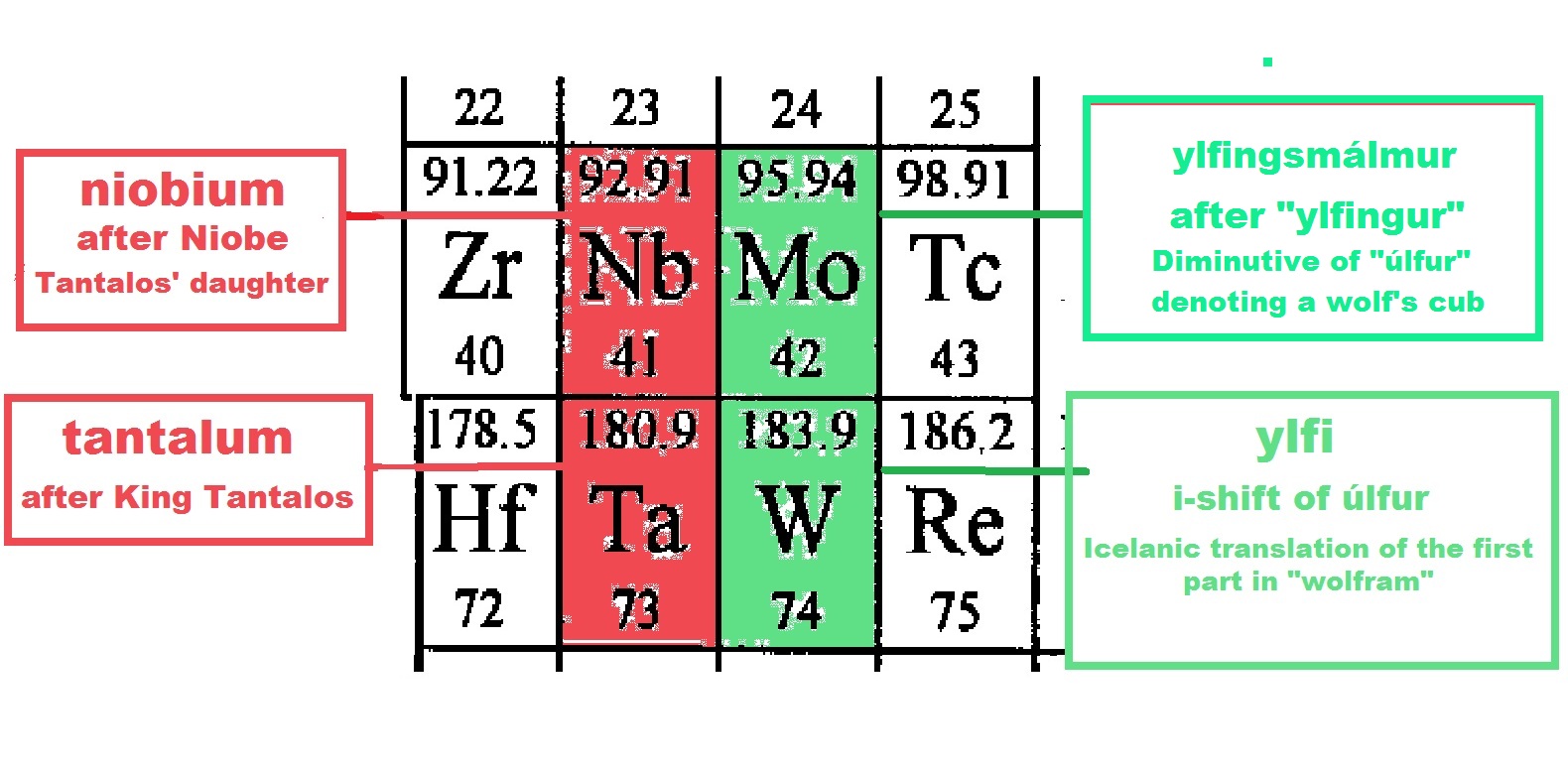
1) ylfingsmálmur (ylfingur = wolf's cub, refers to molybdenum as the lighter brother of tungsten, or wolfram (ylfi, see tungsten), in the same way as niobium, molybdenum's neighbour in Group 5B, was named after the daughter of tantalos, whom tantalum was named after.)


2) blýantylfi (pencil-wolfram): The people who lived near Knaben used molybdenite for pencils like graphite, which warrants the term "blýantylfi" (pencil-wolfram). For the second element ylfi, see Tungsten)
The term blýantylfi is equally long as molybdenum. It has the same amount of characters, same amount of syllables, while it refers to the right substance "ritblý" (literally "writing-lead", graphite) instead of a mere translation of the Greek molydos (lead).
The cabin hosts at Knaben Farm have, of course, always known they greyish, lustrous, pencil-like substance that is found there. Already in 1795 the Etatsråd Holm was on inspection, confirming that some good "blianterts" (graphite-ore) was to be found around the mountain. The substance was sold in the city in the form of pencils (Icel. blýantur) for the same price that you get for butter. It was discovered that the substance could serve as a lubricant for wagon wheels as well.
In 1810, Lieutenant Floor was on an "Economic trip" in Knaben on behalf of the Society for Development in the hope to ascertain that the substance was graphite. But two years later the report concluded that it simply was not graphite, but molybdenum, which had no commercial value". http://www.knaben.no/?vis=artikkel&magasin=&fid=4808&id=0408200815025528307&t=Historikk (first two paragraphs)
 

3) ritblendismálmur
Because molybdenite (MoS2) it is a "deceiving" sulphide mineral, which has the appearance of graphite but is a completely different substance), we can use the term ”blende” (Icelandic ”blendi”) as the second element in a compound-name for the mineral. The term ”blende” was derived from the German ”blenden” (deceive) and in its most original meaning denoted zinc blende or sphalerite (ZnS), which was thought to contain ”lead” but yielded none.  This is the German wikipedia article about "blende".  http://de.wikipedia.org/wiki/Blende_(Mineralogie). The term applies a thousand percent to molybdenite.
Molybdenum was first discovered in Knaben by the shepherds who saw something glistening in the sun on a rock. They took some of the substance home with them, and it turned out that they could write with it just like a pencil. This rock was called ”pencil mountain” (blýantsberget) What the shepherds found was most probably molybdenite. A Swedish chemist named Karl Wilhelm in 1778 showed that molybdenite consisted of molybdenum and sulphur. ( translation of : http://kurs.uia.no/iktl/studentprosjekter/inf105/2006/inf10508/html/knaben/gruvesamfunnet.html
see also http://www.mindat.org/loc-48314.html. 
This is interesting: molybdenite was actually used as a pencil to write with , so instead of "ritblýsblendi" (graphite-blende), we can just call it ritblendi (the first 5 characters in "ritblendi" happen the same as in those in "ritblý", which is a very lucky convenience. So the meaning of ritblendi is: the deceiving sulphide mineral which was used instaed of real graphite to write with. This can only be a description of Molybdenite. So the name for the metal becomes: ritblendismálmur

4) léttylfi, ylfissystir (means "light wolfram" or "sister of wolfram (used "systur" to retain vocal-harmony, which is actually a Finnish grammatical feature)". Molybdenum is actually the softest metal of the chromium group.  On Mohs' scale, chromium scores 8.5-9 (the hardest metallic element in nature, being almost as hard as corundum, the second hardest mineral after the diamond), molybdenum 5.5 and tungsten 7.5.
5) knefi (neuter-noun derived from Norwegian place-name Knaben, where the world's first dedicated molybdenum mine was situated):
The "Samlagets Norsk stadnamnleksikon mentions": Knaben, farm, busstop and post-town in Kvinesdal municipality, Vest-Agder. Originally a mountain name. The word knape (masc.) "rocky knoll" is very commonly used for for mountain peaks in Agder, both in compounds and on its own. Dilaectal variants are nape and nabbe (along the coast). (translation)
A. Torps etymologisk ordbog mentions for nape: A rocky knoll which protrudes from a surface. The word is related to the old Icelandic Knafahólar. (translation) 
The Icelandic word for molybdenum could be the i-shift derivation of the first element in this name: knefi (neuter noun)

13) technetium 
1) gervisilfur: the artificially made metal on the period of silver
2) nýmálmynja (the new metalless (manganese), see manganese)

14) ruthenium
gerskaglit, gerskasilfur (The adjective"gerskur" refers to Gardaríki, which was situated in Ukraine, which is appropriate because the latinized form of Russia, Ruthenia was applied to the Ukraine see http://www.vanderkrogt.net/elements/element.php?sym=Ru  This means the use of "gerskur" is 100% justified in this case.

14) rhodium
eðalsilfur (the noblest metal on the period of silver)

15) palladium

1) nýhvítgylli ("new white gold", "neoplantinum" because it is the homologue of platinum discovered later than its heavier brother)
2) svampsilfur, svampglit (sponge-silver, because it is located right left from silver and also because of its reputation as a "the metal sponge", which refers to the metal's unchallenged capacity to absorb an enormous amount of hydrogen gas. As it absorbs the hydrogen, it expands visibly, like a sponge swelling up when absorbing water.
http://www.chemicool.com/elements/palladium.html (key-word "sponge")
http://www.gold-eagle.com/gold_digest_00/dines030300.html

15) silfur
jarlsmálmur
A appropriate synonym for “silfur” would be: jarlmálmur (earl-metal).  In the SnorraEdda the three highest ranks of nobility were successively: emperor (keisari), king (kóngur, konungur) and earl (jarl)
Maður er hver fyrir sér, Hið fyrsta og hið æðsta heiti manns er kallað keisari, því næst konungur, þar næst jarl. (Snorra Edda, skáldskaparmál, LXXIX)
The term jarl was also mentioned as a translation of “viceroy” in the Ensk-Íslensk orðabók með alfræðilegu ívafi, along with the synonymous undirkonungur.

From the viewpoint of modern chemistry, gold isn't the noblest metal in the sense of "corrosion resistance". With regard to this property, the honour is actually Iridium’s. Nevertheless, gold has always been seen as “the king of metals” and the metal "desired by kings" (especially Old Icelandic literature). Aqua regia (kóngavatn), the strongest acid was so-named because it dissolved “gold”. Silver, gold's lighter brother on the periodic table has always had the reputation of being the "second most noble of metals". This is expressed by the saying: "speaking is silver, silence is gold".  These examples show that ‘jarlmálmur’ does well as an alternative designation for “silfur”. 
Keisaramálmur (emperor-metal, Iridium) can only be the name for a metal that resists kóngavatn (aqua Regia), gull (gold) is the king and silfur (silver) the earl (jarl).

16) cadmium
blendissilfur: Blende in its narrowest and original meaning designates sphalerite or zinc blende Zn(Fe)S.  This can be compared to the term "salt", which denotes in its narrowest meaning the compound NaCl. Now "zinc blende" or "blende" will always contain small concentrtions of zinc's heavier homologue cadmium.  For that reason we can call cadmium "blendissilfur" (the homologue of zinc in the neighbourhood of silver)

17) hafnium
1) hafnarefni (Copenhagener, Hagener element), hafnarylfi (Copenhagener, Hagener wolfram): The second part in the Icelandic name for Copenhagen (höfn (genitive -hafnar) from Kaupmannahöfn) is sometimes used on its own in reference to the city: Hafnaríslendingar has been in use to refer to Icelanders who had settled in Copenhagen.  The second element could be simply efni (element, -ium) or ylfi (wolfram, tungsten), a horizontal positioning marker to point to "heavy refractory metals" on near tungsten, which is the most well-known "heavy refractory metal")
2) danskmálmur, danaþungsteinn. It was Niels Bohr who prefered the name Danium above hafnium, but the latter term was ultimately chosen. http://elements.vanderkrogt.net/element.php?sym=hf
I personally like the term danaþungsteinn, because the element belongs, like tungsten to the so-called "refractory metals", a class of metallic elements that are extraordinarily resistant to heat and wear. Tungsten is a typical example and Hafnium and is situated only two places right from tungsten on the same period. See http://en.wikipedia.org/wiki/Refractory_metals
3) þungþyrsi (Titanium = þursamálmur, þyrsi, so þungþyrsi refers to the heaviest element in the titanium group, which is hafnium.  The convenience of having "þungur" (heavy) as the first element in this compound lies in its alluding to "þungsteinn" (tungsten, wolfram), which is situated only two places right of hafnium and which belongs, like hafnium to the "heavy refractory metals" http://en.wikipedia.org/wiki/Refractory_metals

18) tantalum

1) kóngsylfi ("king's tungsten", "king's wolfram".)
The first element kóngur (king) refers to King Tantalos, after whom the element was named. Apart from that is tantalum's almost complete immunity to attack by acids and liquid metals. It equals glass in resistance to acids and it is impervious to liquid metals up to 1650°F.  This makes the expression "royal tungsten" an appropriate choice.
For the second element ylfi, see Tungsten;
2) tálvonamálmur, tálvonaefni, tálvæni
Secod option is the use of the Icelandic translation of "tantalizations": tálvona- (from the Icelandic equivalent of the English verb "tantalize": kvelja með tálvonum and add málmur or efni.  In this case, glit might better be avoided for it give rise to a confusion with glópagull, FeS (Fool's gold, an iron-compound that looks like gold but is worthless). A word like tálvonaglit would unfortunately be a perfect designation for fool's gold.  Unfortunately, tálvonamálmur is inconveniently long and tálvonaefni is even a syllable longer. Of course you can reduce it to tálvæni, it has the initial "t" and two other consonants in "tantal", but you have to sacrifice transparency by omitting an element marker like -málmur, or -efni.
3) freyjuþungsteinn
A very interesting combination is freyjuþungsteinn. Tantalum is a member of the Vanadium group, named after its first member vanadium (named after Vanadís, a nick-name of the godess Freyja). The element belongs to the so-called 'Iron-group of transitional elements', so Freyjujárn was an obvious choice for Vanadium. Since Vanadium is the main and most abundant element of its group, the prefix freyju- could be used as a prefix to coin names for Niobium and Tantalum. In the case of Niobium, situated right below Vanadium on the period of silfur, freyjusilfur would be an obvious choice. Niobium is used in metal alloys for nonallergenic juwelry, which makes "silfur" as second element even more appropriate. And since tantalum is situated immediately left of tungsten, belonging to the so-called 7th period "refractory metals" (Hf, Ta, W, Re), freyjuþungsteinn couldn't be a more obvious a choice.
4) Compounds with þrá: þrámálmur, þráglit, þrávitisglit, eyþráglit, þráylfi:
Þrámálmur or þráglit could work.  It is maybe an advantage that þrá- in compound can stand for 'desire' as well as "obstinateness".  Tantalum is a "stubborn metal" in its being so chemically resistant to acids and þrá- can at the same time express Ekeberg's idea of "eternal unfulfilled desire". But then again: "þrámálmur" could be an alternative description for "gold", the metal desired by all.
Þrávíti (hell of desire and longing) is a nice name for the "penitentiary hereafter" king Tantalus was sent to would be"þrávíti" (hell of desire).  I choose "glit" as a second element because tantalum is a lustrous metal and it is so acid-resistant that some chemists tend to see it as a seminoble metal.
5) fimbulylfi (fimbul- element of group 5B + ylfi (tungsten), the "tungsten" in group 5B)


20) tungsten
1) þungsteinn
2) ylfi
The neuter noun ylfi (i-shift of úlfur (wolf)) is a reduced Icelandic solution for the other name "wolfram" (or "volfram"), used for example in most European (especially Germanic and Slavic) languages. The name of the element is derived from the mineral wolframite, and this is also the origin of its chemical symbol, The name wolframite is derived from German "wolf rahm" ("wolf soot" or "wolf cream"), the name given to tungsten by Johan Gottschalk Wallerius in 1747. This, in turn, derives from Lupi spuma" the name Georg Agricola used for the element, which translates into English as "wolf's froth" or "cream" (the etymology is not entirely certain), and is a reference to the large amounts of tin consumed by the mineral during its extraction. This property of scheelite, wolvishly devouring tin in the smelter, can already be expressed by "úlfur" on its own, no need to add "ram" (froth). The shortest possible name, which is still transparent and flexible is the neuter noun ylfi, the i-shift derivation from úlfur (wolf), created in the same fashion as ildi (oxygen) from eldur (fire), vetni (hydrogen) from vatn (water), hyldi (nitrogen) from hold (flesh). One can compare this reduction of word-lenght to the construction of pet-forms of Icelandic personal names where only the first part of a compound name: Adda from Aðalheiður, Gunna from Guðrún. (see Tungsten).
2) baskamálmur, baskaglit:  In 1783, José and Fausto Elhuyar succeeded in isolating tungsten and were credited with the discovery of the element. They were Basques, not Spaniards.  So tungsten was a discovery of the Basque Country, not of Spain. For that reason It can be called Baskamálmur or Baskaglit. Read the following:
Elhuyar was founded in 1972 with the goal to promote the use of the Basque language in science and technology. In 2002, Elhuyar was turned into a foundation, out of which two companies developed: Elhuyar aholkuaritza and Eleka Ingeniaritza Linguistikoa. The latter is a company that offers services in the field of speech technology. The name Elhuyar originates from the two Basque brothers José and Fausto Elhuyar, who jointly discovered the element Wolfram, the most important discovery of the Basque country. (see http://www.mlta.uzh.ch/teaching/iw/iw-2012/EN_Baskenlandbericht-.pdf )


21) rhenium
1) torsuðumálmur, torsoði (The lustrous (noble) metal with the highest boiling point of ALL elements.
Rhenium is now known to have the highest boiling point of all metals and elements. Tungsten is known to have the highest melting point and was until recently thought to have the highest boiling point too, but no, that honour goes to rhenium
It's close win indeed, but still, a win. Sufficiently to found a term upon:
Rhenium belongs to the so-called refractory metals. See  http://en.wikipedia.org/wiki/Refractory_metals .  The Ensk-Íslensk orðabók með alfræðilegu ívafi mentions for the entry "refractory" as a metallurgical term: torbræddur, torunninn, the first one of which is typical for tungsten, which has the highest boiling point. This gives me confidence that starting the name of a refractory metal like rhenium with tor- is terminologically appropriate.
2) eðalþungsteinn: the element immediately left from tungsten that is included in the list noble metal. see http://en.wikipedia.org/wiki/File:Edelmetalle.jpg 
3) rínylfi (A ompound of Rín- (Rhine) and ylfi (see tungsten)
The problem with this term is that rhenium, although situated right to the left of tungsten while sharing many physical properties with it in its capacity of being a refractory metal, it has nothing to do with the property of "devouring tin in the smelter", which gave rise to the name "wolfram" and my personal coning ylfi. Still, this doesn't have to be a deal-breaker. I believe we could use "ylfi" as a positioning marker for the heavier refractory metals neighbouring tungsten and of course as a second element in the name of its lighter homologue on the 5th period, molybdenum (linylfi, "soft tungsten")
4) þungmálmynja ("the heavy (natural) element in the manganese group".   See http://en.wikipedia.org/wiki/Refractory_metals Manganese = málmynja, the female metal, because pyrolusite, the chief manganese ore was originally called "the female black stone of magnesia, where magnetite or magnetic iron ore, which occured allong with pyrolusite was considered to be the male counterpart).  The term málmynja can be used for all four members of the manganese group of elements.


22) osmium
1) þefmálmur (The metal was named after the Greek osme meaning "a smell", because of the ashen and smoky smell of the volatile osmium tetroxide. The oxide forms already at room temperature, so the metal really stinks.)
2) blágull (differs from other platinum group elements and noble metals in general in that it possesses a distinct blue lustre. (see http://en.wikipedia.org/wiki/Osmium )


23) iridium
1) keisaramálmur (Iridium is the most corrosion-resistant metal known and isn't attacked by aqua regia (kóngavatn).  In the Snorra Edda, the three highest ranks of nobility are: keisari, kóngur and then jarl).  A metal that can resist the acid that dissolves gold, the king of metals is the "emperor metal".)
2) alvaldsglit (alvaldur, a king or god. This word could have been the perfect word for "emperor" in Icelandic, alvaldfreyja for empress)
3) hrapvottsgull, hrapvottsglit: Iridium is the "witness element" with regard to the extinction of the dinosaurs. This is no futile a property. The last element "gull" is here used in both a figurative sense of "very valuable substance" while it also alludes to its possition on the periodic table two places left from gold.
In Dutch a butte is called getuigeheuvel (witness-hill) so the idea of calling iridium a "witness substance" isn't that far fetched.
In 1980, a team of researchers led by Luis Alvarez, discovered that sedimentary layers found all over the world at the "Cretaceous–Paleogene boundary" contain a concentration of iridium hundreds of times greater than normal. Iridium is extremely rare in the Earth's crust because it is very dense, and therefore most of it sank into the Earth's core while the earth was still molten. http://en.wikipedia.org/wiki/Alvarez_hypothesis
On every rocky planet high concentrations of iridium will be "a witness of a meteor impact". This phenomenon is universal.


24) platinum
1) hvítagull (white-gold, the platinium metals could be called hvítgyllingar)
2) silfringur (The spanish platina is a diminutive of 'plata' (silfur), the icelandic equivalent would be "silfringur".  The platinum metals as a group could be called silfringar.

25) gull

26 kvikasilfur

eðalvökvi

The chalcogen-group of elements (eldfrumefnin)

1) Selenium and tellurium
Non-metals and metals bordering the metalloids are sometimes called near-metalloids:
Nonmetals in this category include carbon, phosphorus, selenium and iodine. They exhibit metallic lustre, semiconducting properties and bonding or valence bands with delocalized character. This applies to their most thermodynamically stable forms under ambient conditions: carbon as graphite; phosphorus as black phosphorus; and selenium as grey selenium. These elements are alternatively described as being 'near metalloidal', showing metalloidal character, or having metalloid-like or some metalloid(al) or metallic properties. http://en.wikipedia.org/wiki/Metalloid


The four málmfrændar (metal cousins) or near-metalloid non-metals

The icelandic terms for "metalloid" mentioned in the Orðaskrá um eðlisfræði og skyldar greinar (Icelandic terminology list of physics and related fields)  are: málmbróðir (lit. "metal-brother"), málmungur (used in the Icelandic wikipedia article) and melmingur. The term hálfmálmur is the translation of "semimetal", which is used to denote physical, not chemical properties like "electrical conductivity".  Many of the elements that are semimetallic are metalloid in their chemistry but the two terms should not to be regarded as being synonymous.
The Icelandic term I create for "non-metallic near-metalloids" (carbon (C), phosphorus (P), selenium (Se) and iodine (I) is an extrapolation of "málmbróðir" (metal-brother): málmfrændi (metal-nephew).  The name for the "more metallic metalloids" (Aluminium (Al), tin (Sn) and bismuth (Bi) could be "nærmálmur".
If you look at the initial image of the periodic table on the English wikipedia site on metalloids you see that selenium is the only one that is marked pink, which refers to its being uncommonly included in the list of metalloids, unlike carbon, phosphorus and iodine (marked in yellow), whch are rarely included. Polonium is a "nærmálmur" and astatine is so radioactive that its is very difficult to establish its place on the chemical spectrum between metallic and non-metallic. This means that selenium is actually the "prototype of a "non-metallic near-metalloid". It is the only element that has left chemists in doubt about its addition to or exclusion from the list of metalloids, it is a málmfrændi (metal-cousin). This means that the term málmfrændi on its own could already do well as a name for selenium. But there's a way we can terminologically isolate the element more thoroughly and in the proces create a name for its chemical brother telerium in a way that we end up with the same terminological harmony that is found in the existing names: tellurium (named after the Roman earth-godess Tellus) and selenium (named after the moon-godess Selene).
The elements marked in red are metalloids (málmbræður), those in orange are the non-metallic near-metalloids (málmfrændar), those in yellow the non-metals (málmleysingjar) and the halogens (söltungar) in pale-yellow. Those marked in lilac are the nærmálmar, the "more metallic near-metalloids". Outlined in green are the elements that are named after female entities: Vanadium after Freyja (Vanadís), Niobium after King Tantalos' daughter Niobe, Palladium is called after the asteroid Pallas, which in its turn was derived from the nick-name of the Greek godess Athene, Iridium after Iris, the godess of the rainbow.  Note that these four are all metals. Apart from metallic elements, there are only two elements named after female entities: selenium and tellurium, respectively named after the Roman moon- and the earth-godess. This means that we can perfectly isolate selenium and tellurium by making reference to these female entities. We can do this by femininizing the kinship term "frændi" to "frænka" for selenium: málmfrænka and "bróðir" to "systir" for tellurium (málmsystir).

Some say that both elements were named just after the moon an earth and not the godesses.  But that's not important.  Both names are feminine in their languages of origin.  In her book "Discovery of the elements", Mary elvira Weeks writes: "Since Klaproth had named tellurium for the earth, Berzelius thought it appropriate to call the SISTER-element for the earth's satellite."  If you google "selenium" along with "sister-element" you get a lot of results, while googling it along with "brother-element" yields none.  This gives me confidence that the use of the female equivalents of "málmfrændi" and "málmbróðir" for selenium and tellurium respectively is fully appropriate.

The good thing about these terms is that they reflect the terminological harmony found in the international names of the two element.  When we include these terms in the list of names of the oxygen group of elements, the slight increase in metallic properties from oxygen to polonium is nicely reflected:  ildi and brennisteinn (judging from the names, these are no metals), málmfrænka (slightly more metallic that sulphur, but not yet a true "málmbróðir"), málmsystir (the metallod named after a female entity) and maríublý (polonium, a near-metalloid metal named after Marie curie. The element is situated two places to the right of lead, which is the reason I took "blý" (lead) as the second element. "Blý" also emphasizes the more metallic character of polonium.

2) List of oxygen-group elements:

1) Oxygen: ildi (súrefni, OR fúrefni, fjörloft, ozone: bláildi (blue oxygen), þrildi (three-oxygen, contraction of þrí-ildi)
2) Sulphur: brennisteinn (OR hveragula, múspellsmold, ildisbróðir, surtshallur, surtssand. Existing synonyms could be the danicism svola, from svolustaukur (eldspýtnabaukur, from Danish svovlstik), fiði, a neuter form of fiða (Íslensk Orðsifjabók) or fiðusteinn ( http://lexis.hi.is/cgi-bin/ritmal/leitord.cgi?adg=daemi&n=108646&s=128870&l=fi%F0usteinn )
3) Selenium:
1) málmfrænka (The near-metalloid non-metal (málmfrændi) named after a female entity) the moon godess Selene.
The only other possibility is melmingur, the third and least used of the three terms for metalloid mentioned in the Orðaskrá um eðlisfræði og skyldar greinar (the other ones are málmungur and málmbróðir).  Because the i-shift in melmingur makes it sound less like málmur than málmungur, it could be interpreted as "less metallic in its chemical properties".  In this respect it could serve as a name for the near-metalloid non-metals carbon, phosphorus, selenium and iodine.
2) kísmelmingur: Selenium, due to its being a homologue of sulphur it is always found associated with the latter in nature, like in the iron-sulphide mineral brennisteinskís or simply kís (pyrite) as iron selenide (FeSe). A term that emphasizes this property is kísmelmingur (the non-metallic near-metalloid in pyrite)
3) nýbrennisteinn.  The prefix neo- (used in "neon", because it was the new, second noble gas to be discovered after argon, the rare-earth element neodymium because it was the new element isoleted from dydymia. Selenium was discovered after tellurium, but this element doesn't compare in its similarity to selenium.  I abandoned the idea of creating a compound with "brennisteinn" for selenium (like "brennisteinsbróðir", because of the resulting word-lenght, but the prefix - is extremely short.  nýbrennisteinn (neosulphur, neothium, neo- + thio- + -ium) isn't exaggeratedly long.


4) Tellurium:
1) málmsystir (The female metalloid (málmbróðir), the metalloid named after a female entity, which can only refer to tellurium, no other metalloid is named after a woman or godess or alludes to something feminine whatsoever.
2) drottningarmálmungur, drottningartin, kóngamálmungur, kóngatin, hirðmálmungur: Tellurium is the predominant element in nature that can form chemical compounds with "gold", the classical "king of metals", like calaverite AuTe2 and sylvanite AgAuTe4.  Gold itself is usually found uncombined, but when found naturally as a chemical compound, it is most often combined with tellurium. A few rare non-telluride gold compounds such as the antimonide aurostibite, AuSb2, and bismuthide maldonite, Au2Bi, are also known, but they hardly compromise the validity of the term " royal metalloid" as a designation of tellurium. Aqua Regia (Kóngavatn) was so-named because it dissolved gold and in the same way we can call the metalloid that predominantly binds to gold the "royal metalloid", "royal tin" or "queen tin", which emphasizes the fact that it was named after a female deity, the Roman equivalent of the Greek Gaia, Tellus.  Klaproth isolated tellurium from the mineral Calaverite (AuTe2), and he could have named the substance after this unique property, but, instead, he named it, in his words, "von der alten Mutter Erde entlehnte" Tellus.
3) Sjöborgartin: (Transylvanian tin): The type-locality of elemental tellurium is Facebaj, Transylvania and many gold-telluride minerals are found there.  http://webmineral.com/data/Tellurium.shtml It was also in Facebaj that the metalloid was discovered in 1782 by Franz-Joseph Müller von Reichenstein in a mineral containing tellurium and gold.  It is funny that tellurium, the element with its type-locality in Transylvania, the so-called 'land of vampires' produces a "garlic breath" on overexposure.
4) múspellstin, surtstin, brennitin: An good alternative name for the collective term chalcogens (meaning the "ore-formers", since 65% of the earths crust is made up by sulphur and oxygen compounds), as the oxygen-group of elements are sometimes called would be "the elements of fire" (eldfrumefnin, shorter than the troublesome málmgrýtamyndarar), because the first two elements, oxygen and sulphur, have been linked up with "flammability" throughout the history of chemistry : ildi (oxygen, derived from eldur (fire) and brennisteinn, brimstone, sulphur, the substance that was regarded, because of its properties as being the intermediate between the classical elements "earth" and "fire" in antiquity). From the viewpoint of Nordic mythology, the logical fuel of the fiery world of Múspellsheimr would be "brimstone", which is comparable to the christian idea of hell as a place smelling of burning sulphur. This means that the genitive of names like Múspells-,  Surtr (Surts-) or brenni- (in brennisteinn) could be useful to accurately position the "postsulphuric chalcogens" Se, Te and Po.
Brennitin would be the equivalent of Brimtin in English. The prefix brim-in brimstone is actually a corruption of the Old English word for "burning" and is unique to this compound, unlike the uncorrupted brenni- in the Icelandic equivalent brennisteinn. So it is easy to coin pure English names for tellurium (brimtin) and polonium (brimlead). But even in Icelandic, if you would ask an Icelandic chemistry professor what element could alternatively be refered to as brennitin (yes, tellurium burns, not as intensely as sulphur, but still, and also the appearance of the element is refered to as "tin-like"), he would horizontally search the latter part of the 5th period, where tin is situated, while running down the list of postsulphuric chalcogens (Se, Te and Po) and easily end up at the place where tellurium is situated.
"Kístin "(pyrite-tin) is an erroneous term!
In contrast to selenium, tellurium is not in general able to replace sulfur in its minerals, due to the large difference in ion radius of sulfur and tellurium. In consequence, many common sulfide minerals contain considerable amounts of selenium, but only traces of tellurium.  So, watch out, I made the mistake, don't call tellurium "the tin in pyrite!". See http://en.wikipedia.org/wiki/Tellurium

5) Polonium
1) maríublý: Polonium is situated just two places to the right of lead (blý) and most of its exceedingly radioactive isotopes represent one of the last stages in the three major decay-chains that end up with lead-isotopes. This makes blý an appropriate choice for a second element in a compound. As for the first part: because the element was discovered by Marie Curie, who named it after her country Poland, it would be appropriate to name it after her.
2) Læsamálmur, Læsaefni, Læsablý: The first part of this compound is an Old Icelandic name for the Polish people: Læsir (masculin plural of Læsur). The Íslensk orðsifjabók mentions:
Læsir, †Lḝsir, Lesir k.ft. † pólskur þjóðflokkur við Vislu, Ljachar, sbr. frúss ljachy 'Pólverjar', lith. lénkas og fpól. lęchь (s.m.) sem er samdráttarmynd (með smækkunarviðsk. -ch) < lędĕninь af lędo 'nýtt land, óbrotið land', eiginl. 'nýlendingar'. Sk. land
Marie Curie was born in Warsaw, which is situated at the Vistula River, so Læsur applies to her, Læsynja, the feminine form of Læsur is even more specific: Læsynjumálmur, Læsynjublý (metal, lead of the Polish woman)
In the early 11th century, Scandinavians referred to the Polish tribe of Polans in the region of Gniezno as Laesar. (see http://en.wikipedia.org/wiki/Lendians and http://en.wikipedia.org/wiki/Polans_(western)
Note that the typically Polish name Lech, which is the first name of the former Polish president Lech Walęnsa, happens to have an Icelandic variant!
The term Lechitic is related to the name of the legendary Polish forefather Lech and the name Lechia by which Poland was formerly sometimes known. http://en.wikipedia.org/wiki/Lechitic_languages
The orðsifjabók also mentions Læsir as a masculine personal name, which is identical to Lech, so Icelandic actually has a form of its own for this typically Polish name: Læsir Valensa (Lech Walęsa, in which the normally nasal sound ę is colloquially pronounced as 'en', so I adapted it to Icelandic as 'en'.
1) Læsir, †Lęsir k. † karlmannsnafn (í fornaldars.) Vísast tengt þjóðflokksheitinu Læsir (3) Íslensk orðsifjabók (see above)
3) púlín, púlínablý, púlínamálmur
If the word has to be constructed in the same style as most other names, where the ending -ium is replaced by -ín (natrín, kalín, kalsín, why not calling polonium PÚLÍN, instead of 'pólon', after the oldest Icelandic form Púlínaland, mentioned in the Þiðreks saga af Bern: En er Vilkinus konungr hefir stýrt þessu ríki um stund, þá býr hann her sinn ok ríðr með ótal riddara ok annarra hermanna út í Púlínaland ok á þar margar orrostur ok stórar bæði.
is a nærmálmur (more metallic near-metalloid). I named it after Marie Curie and the fact that it is situated two places from lead and because almost all of its isotopes ultimately desintegrate into lead isotopes.